
Dashboard
Your launch, at a glance.
See what’s waiting for you, what’s ready to post and which conversations need an answer, alongside what your agents are working on right now.
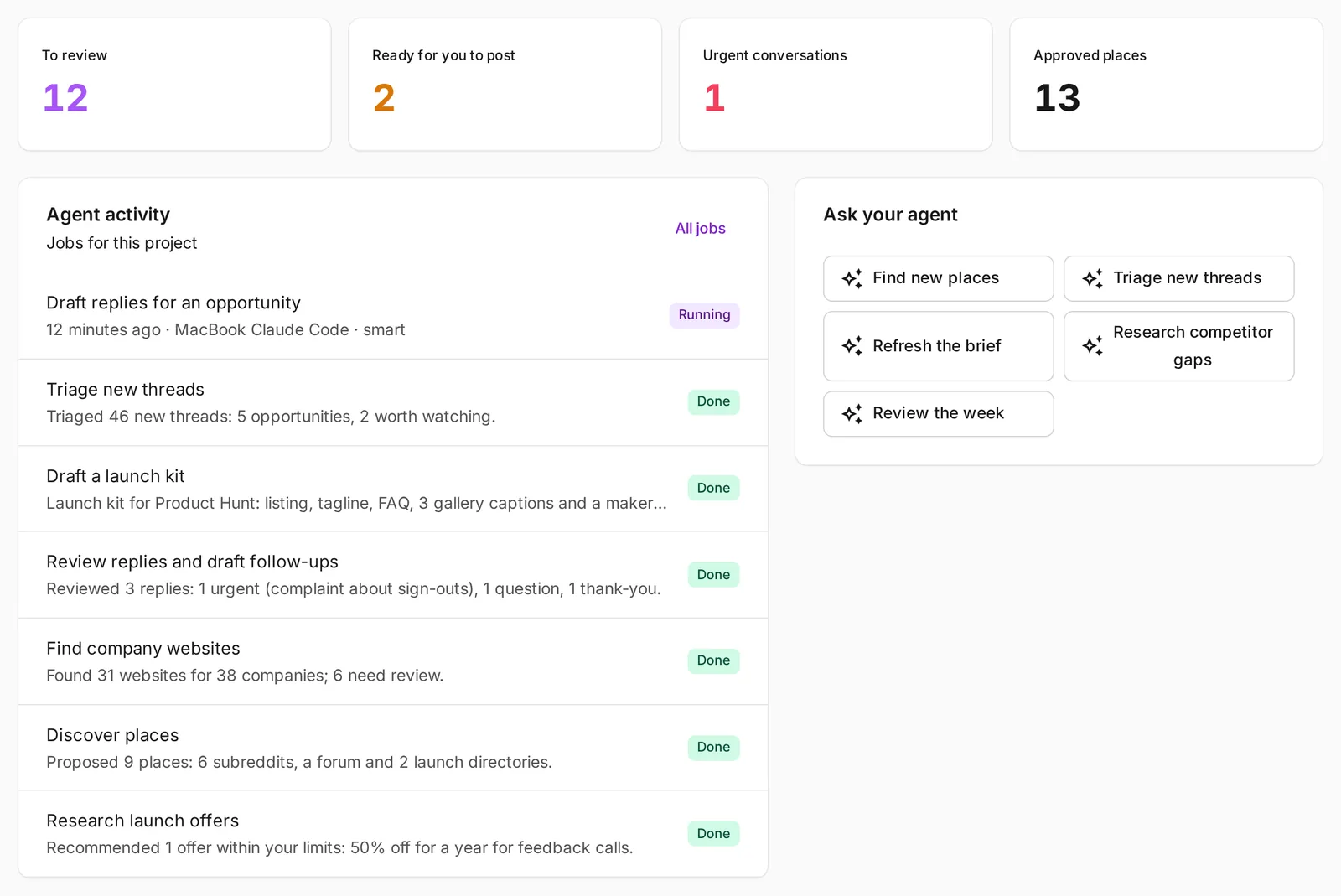
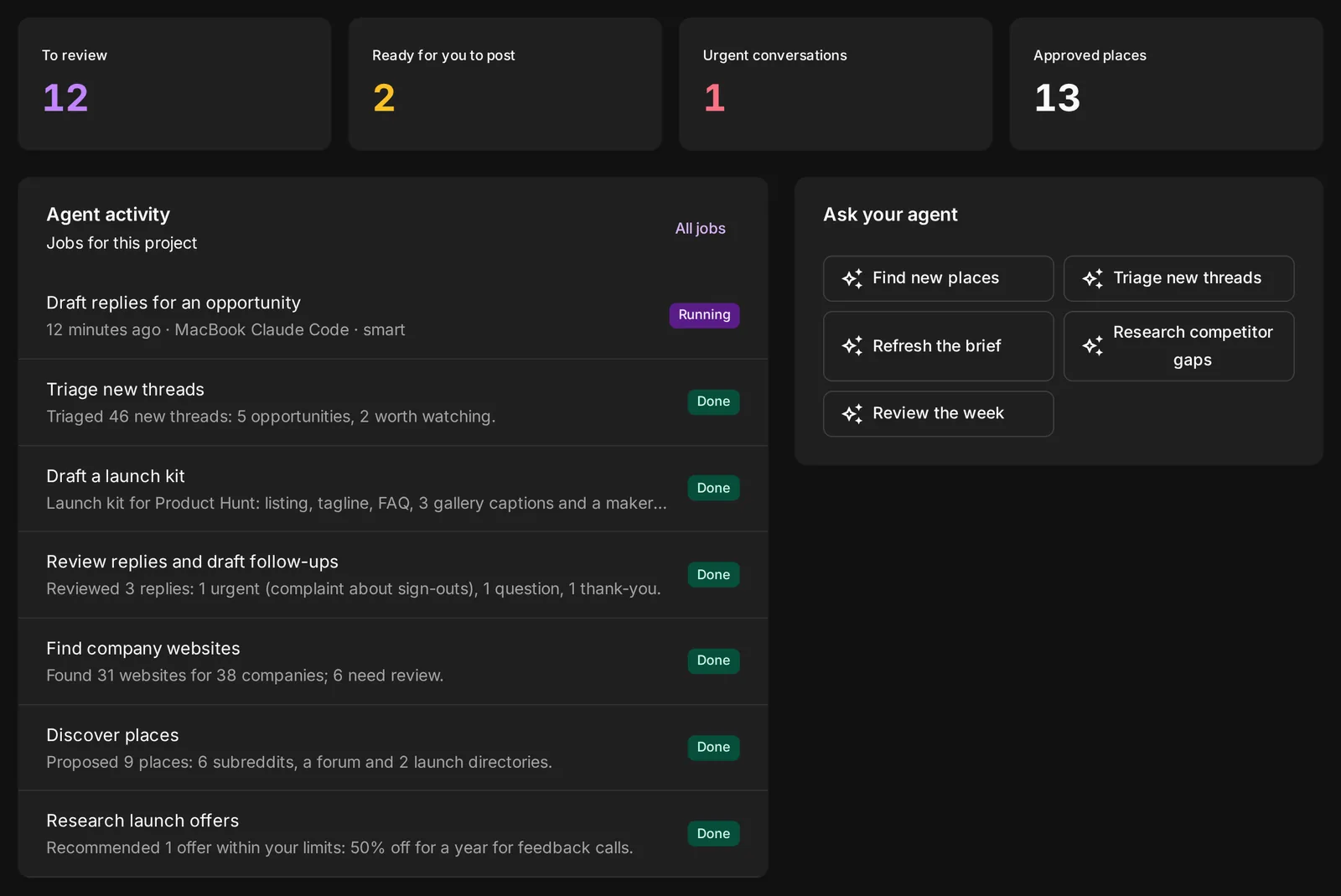


Photo by Michael Lock on Unsplash
Photo by Christian Lue on Unsplash
Spread the Word is a community marketing assistant for product teams of any size, and a perfect fit for new products and lean teams. Your own AI agent finds your audience and drafts posts in your voice, segmented email campaigns follow up with the people and companies you want to reach, and nothing goes out until you approve it.
Spread the Word finds the places your audience talks, prepares posts in each persona’s voice for you to approve, publishes them at a pace each community accepts and keeps track of what comes back. These screenshots show a made-up product, Rotabird, getting ready for its launch.
See what’s waiting for you, what’s ready to post and which conversations need an answer, alongside what your agents are working on right now.
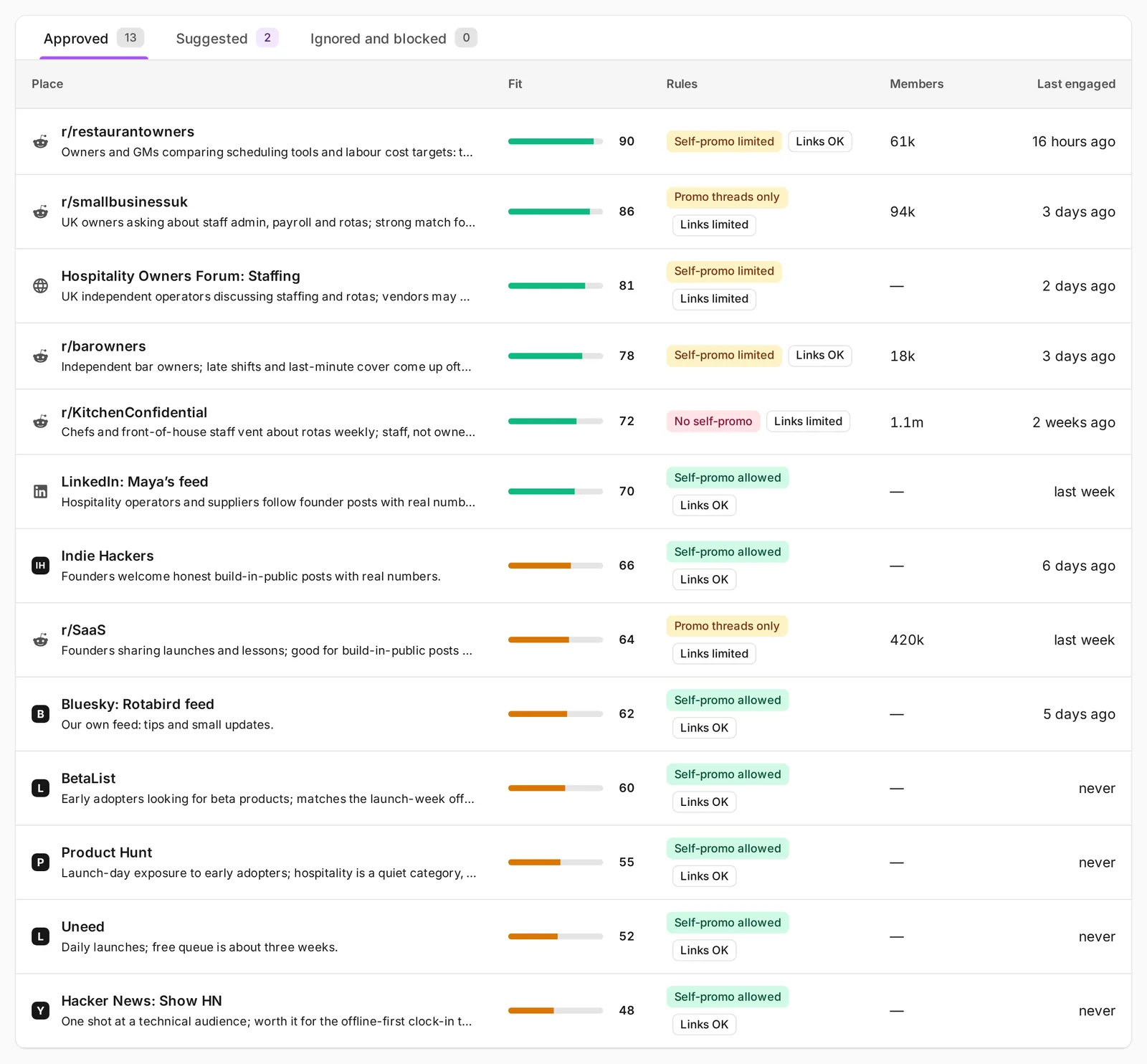
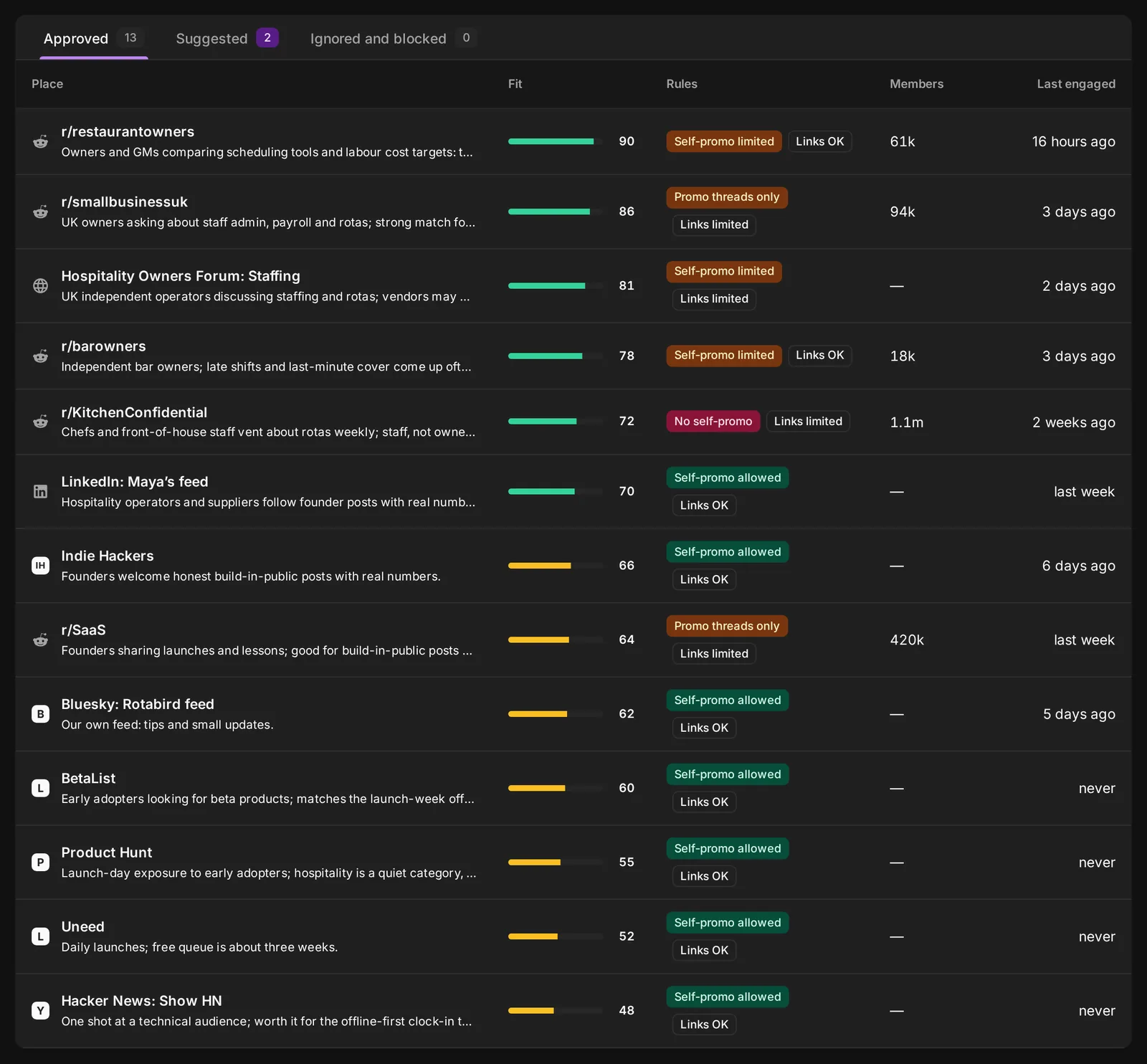
Your agent finds subreddits, forums, Q&A sites and launch directories, scores each one for fit and summarises its rules on self-promotion, so you know where you’re welcome before you say a word.
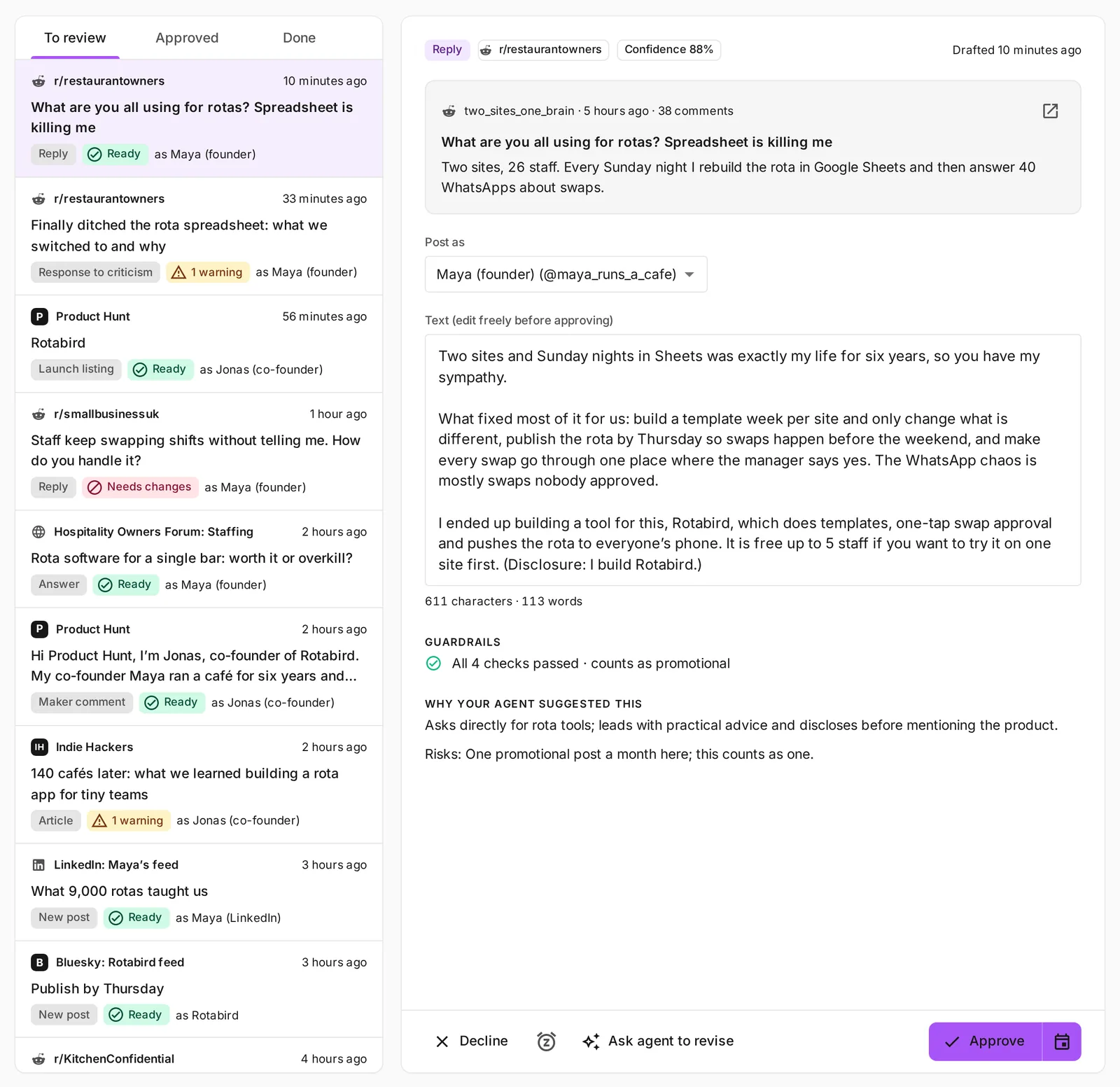
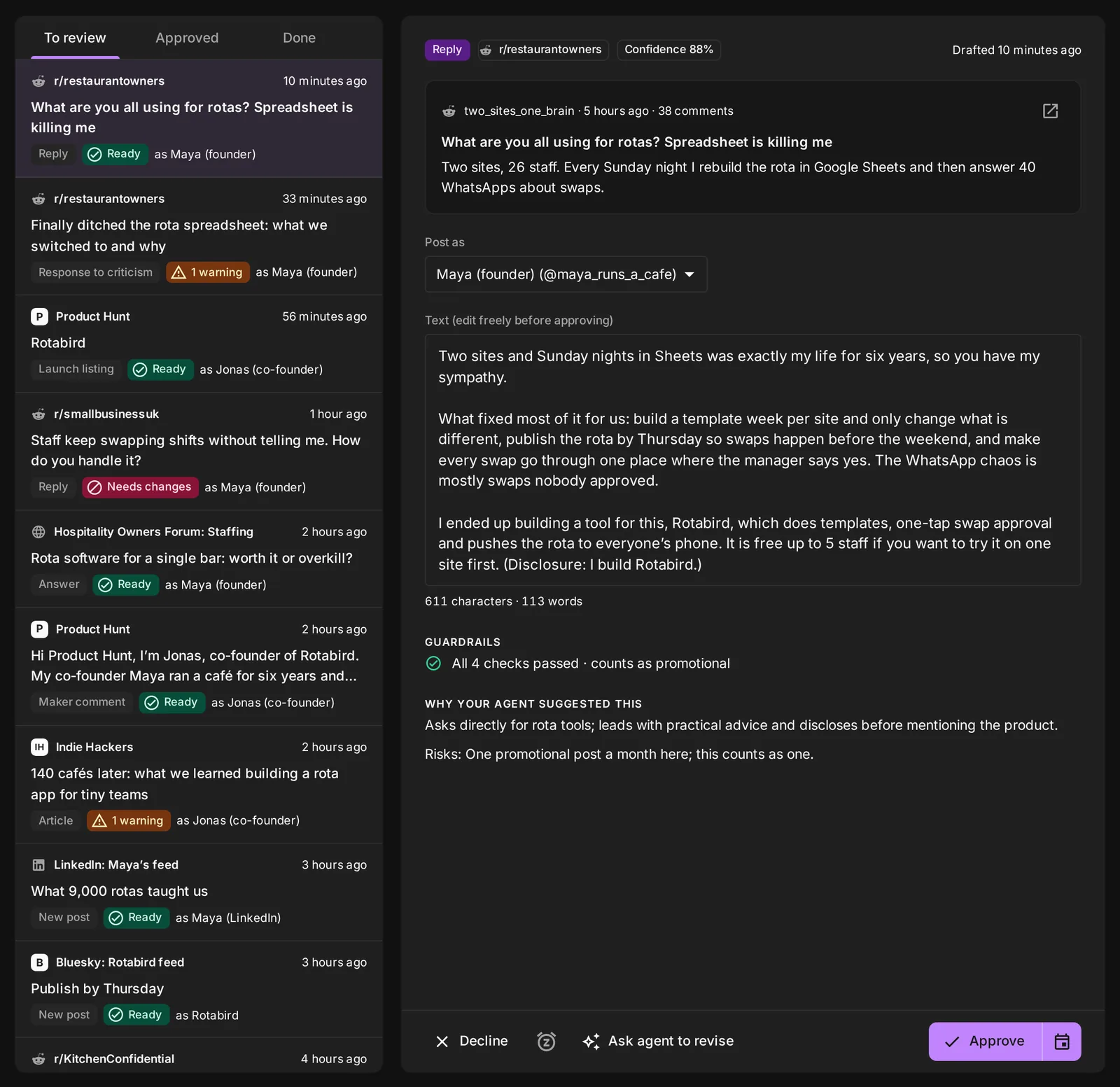
Replies, questions, articles and launch posts are written in each persona’s voice from the facts in your brief. Edit inline, approve, decline with a reason or snooze; nothing is posted until you say so.
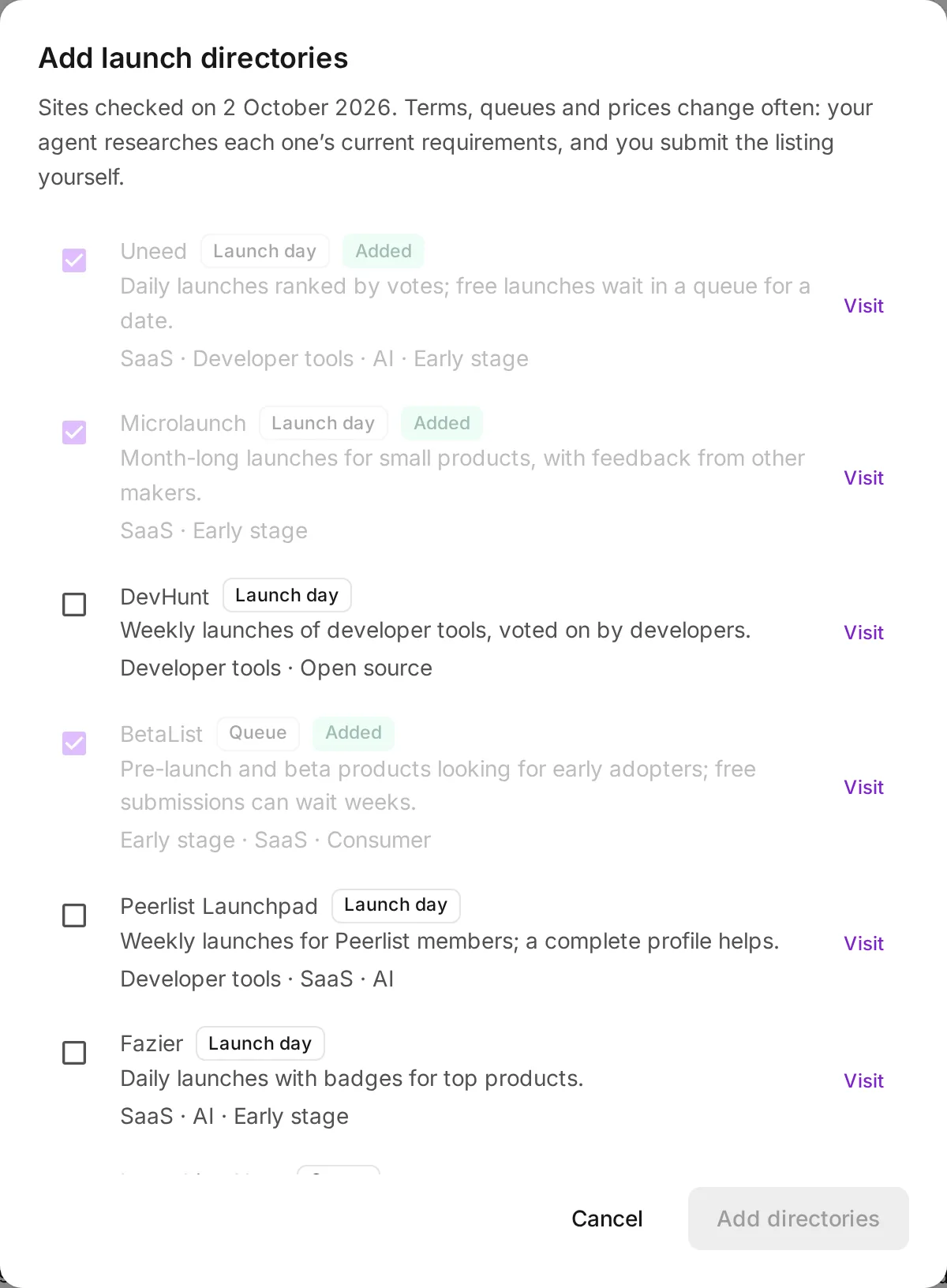
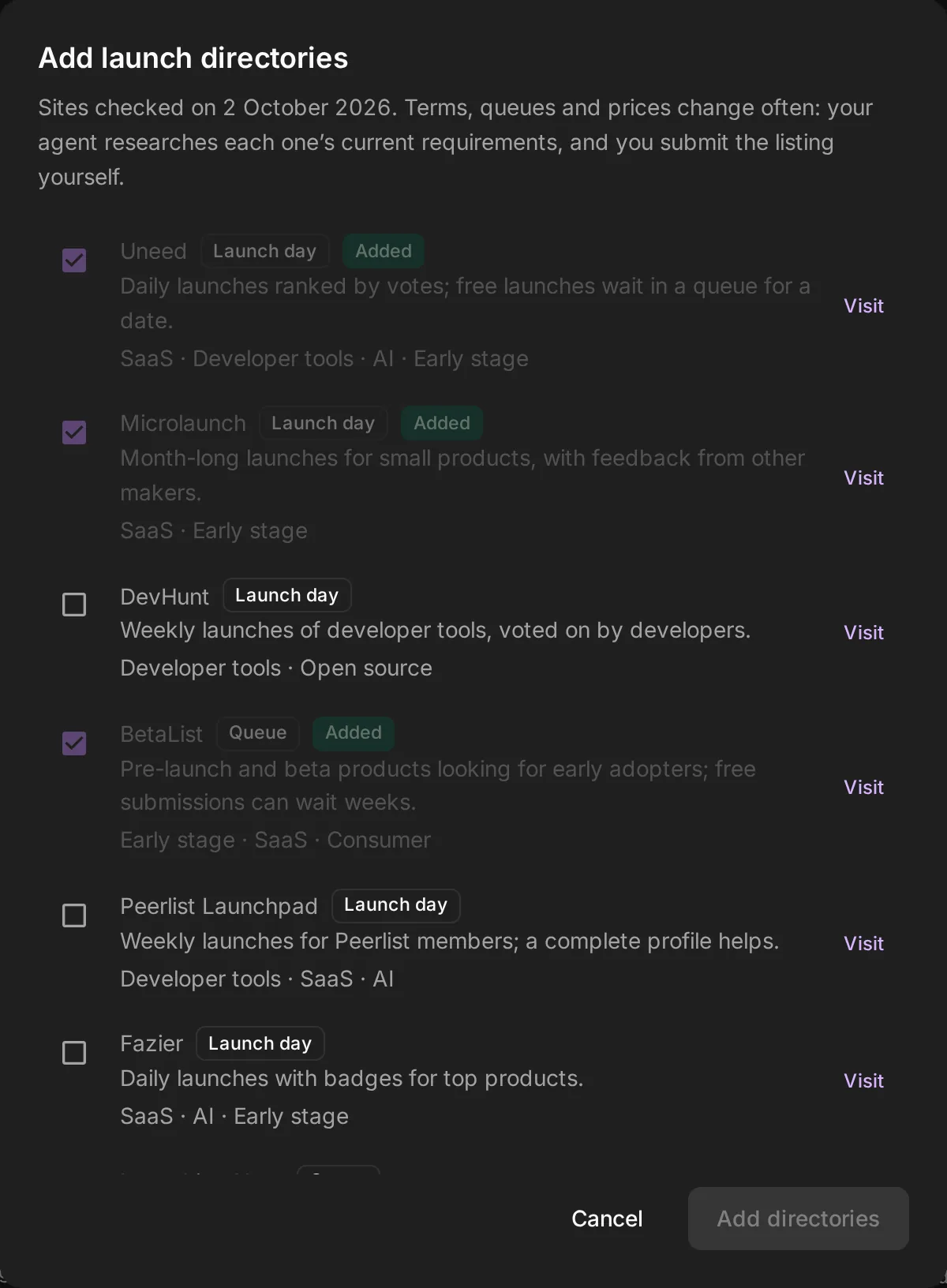
Choose launch directories from a catalogue of 12, including Uneed, DevHunt and BetaList, and your agent prepares a kit for each: listing copy, tagline, FAQ answers, gallery captions, a launch-day maker comment and a checklist of the directory’s current requirements.
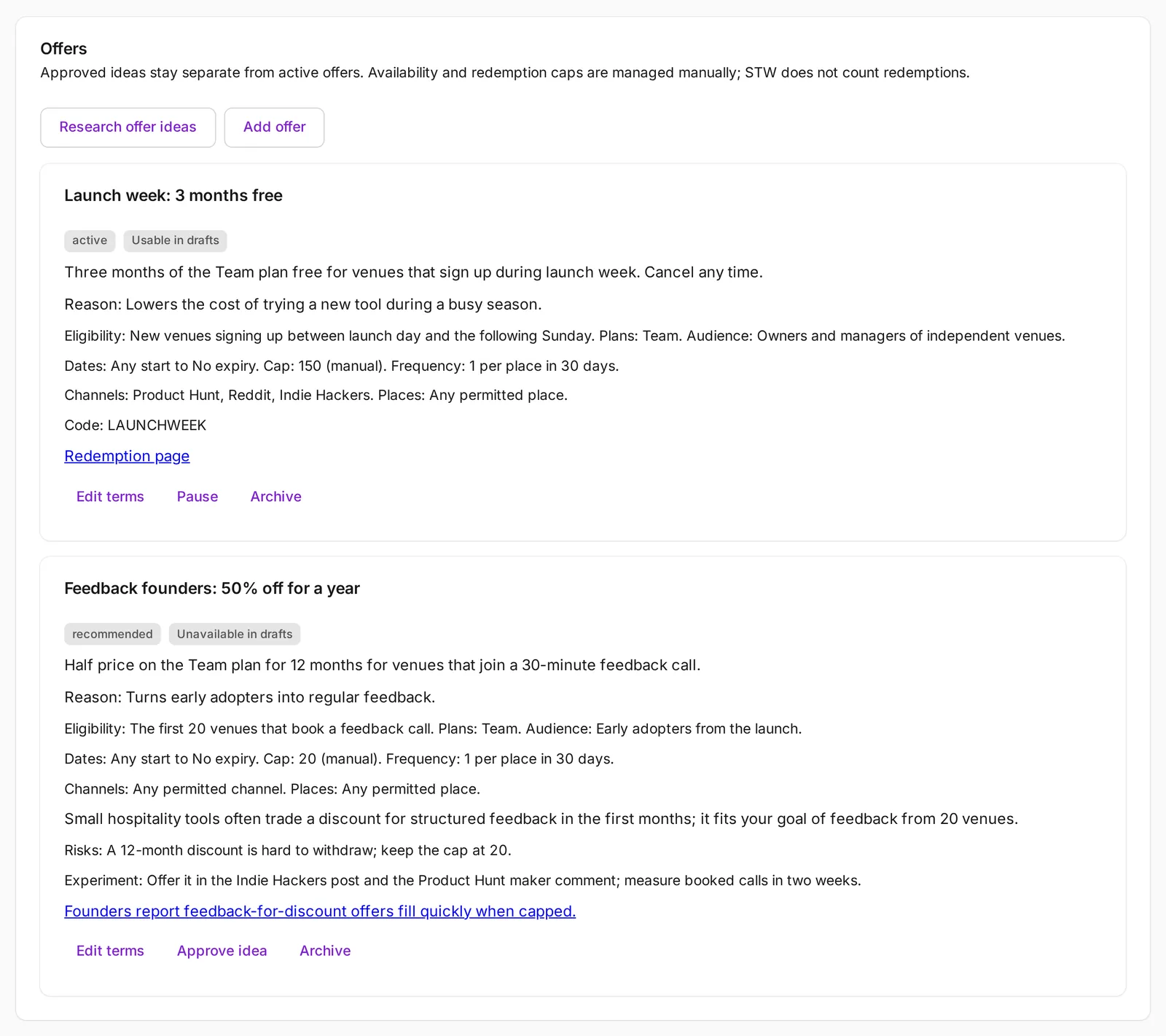
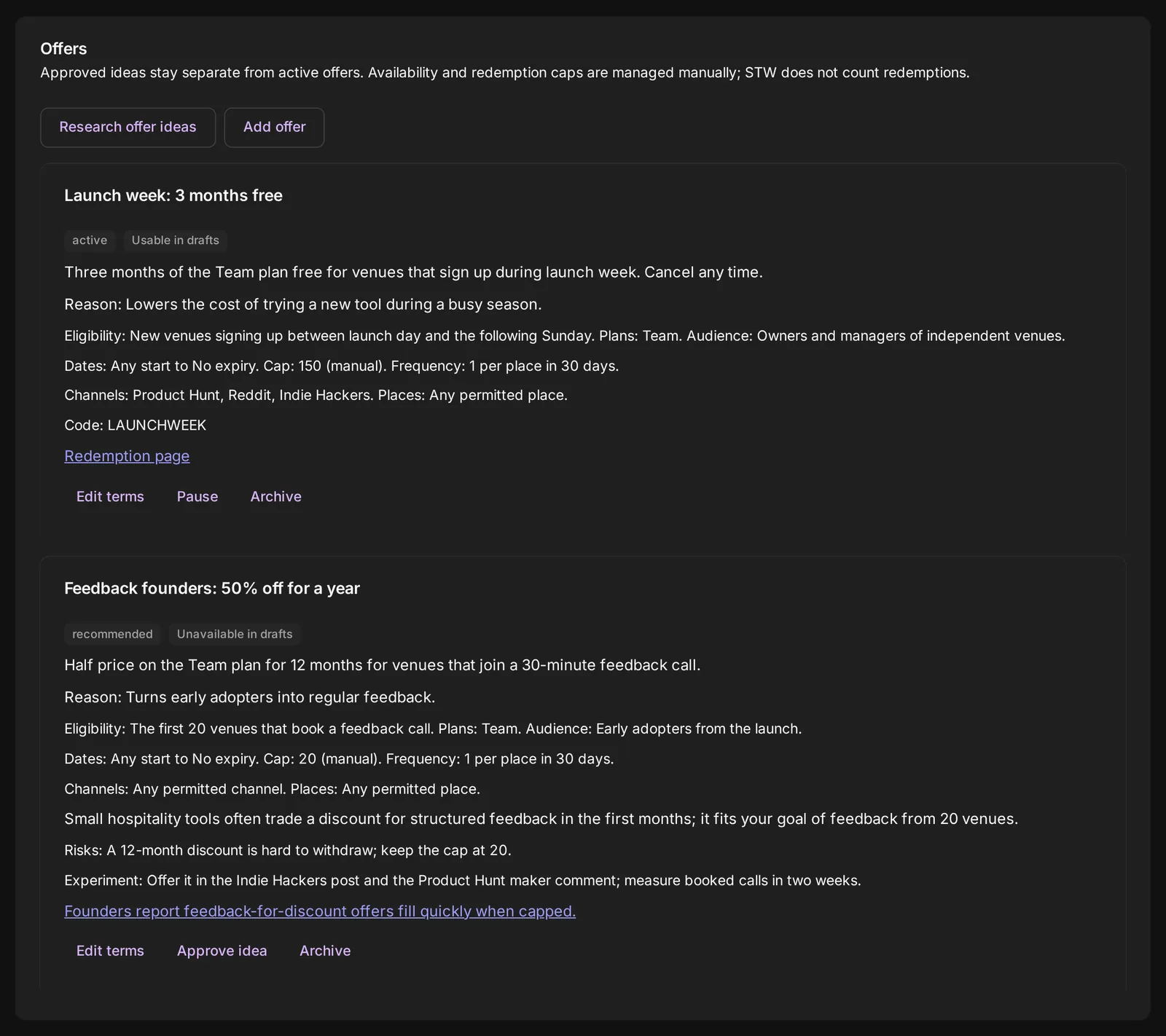
Set the commercial limits, and your agent researches launch and feedback offers with their sources, risks and a suggested experiment. You approve each one and set it up; drafts only use offers that are active and in scope.
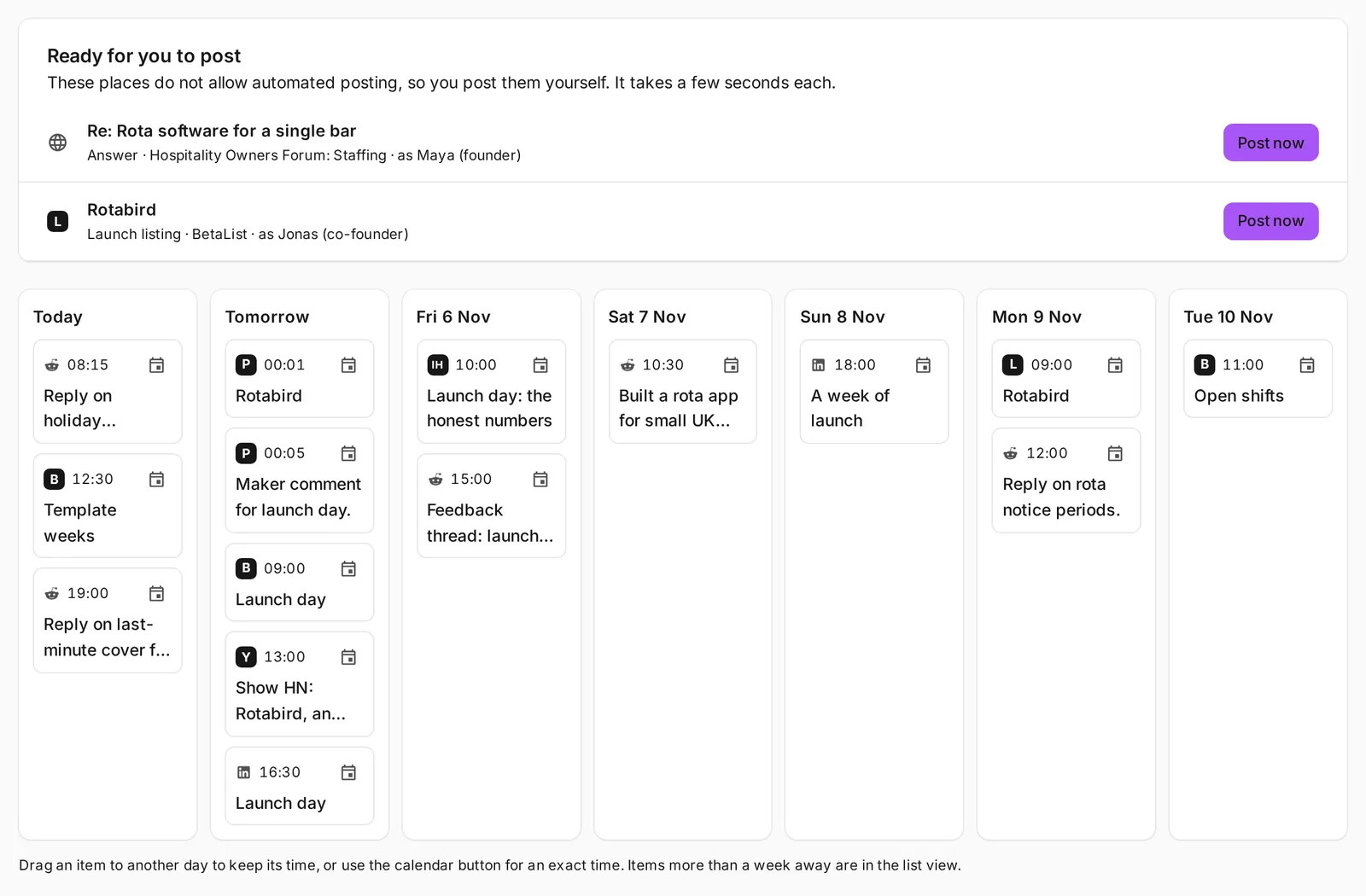
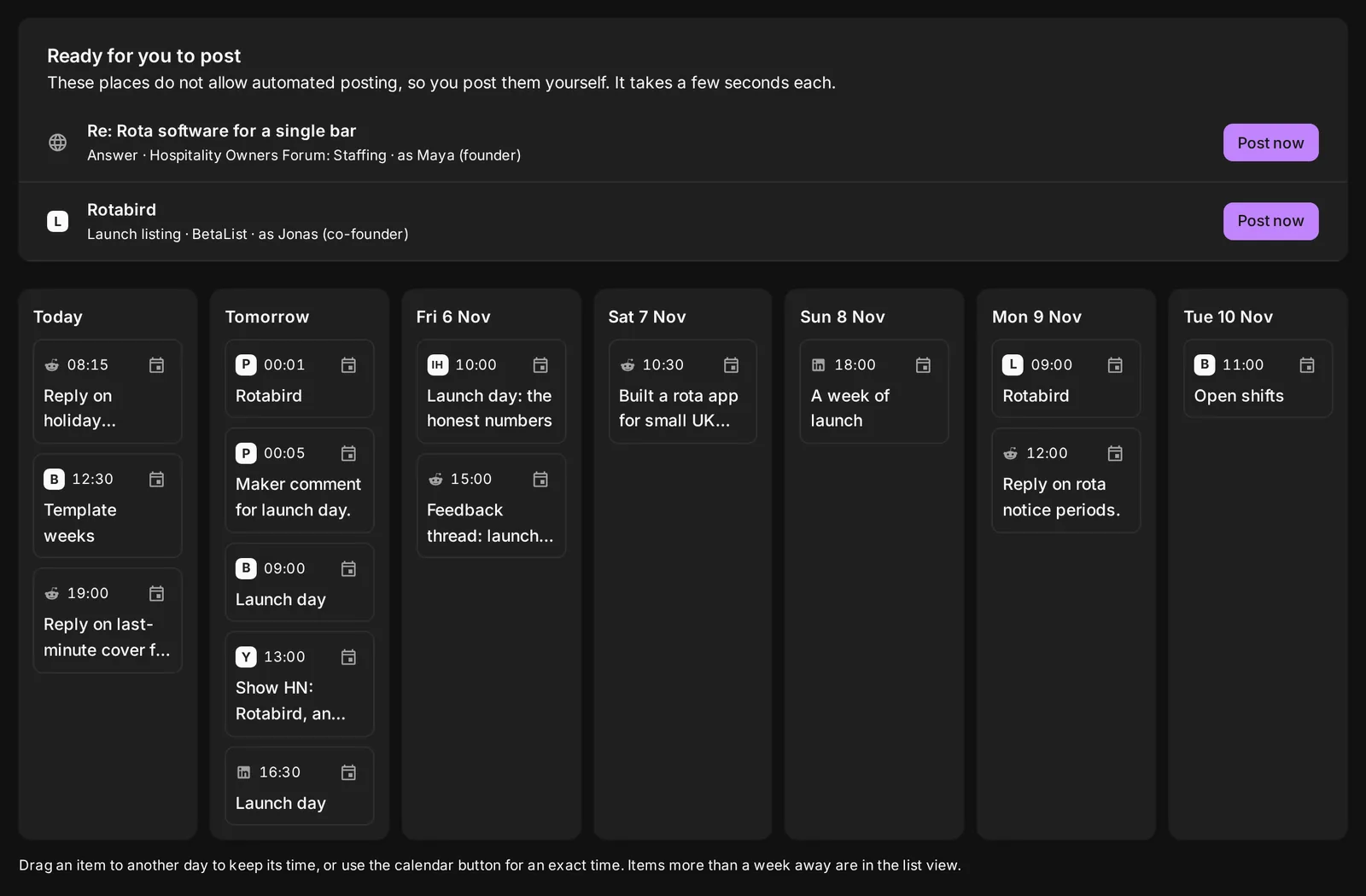
Approved items are scheduled at the time you choose, within each account’s pacing. Platforms with an API publish themselves; for Product Hunt, Show HN and directories you get the text, a checklist and the page to open.
Replies to everything you publish are tracked and sorted. Negative or urgent ones are flagged straight away, with your agent’s advice on how to respond.
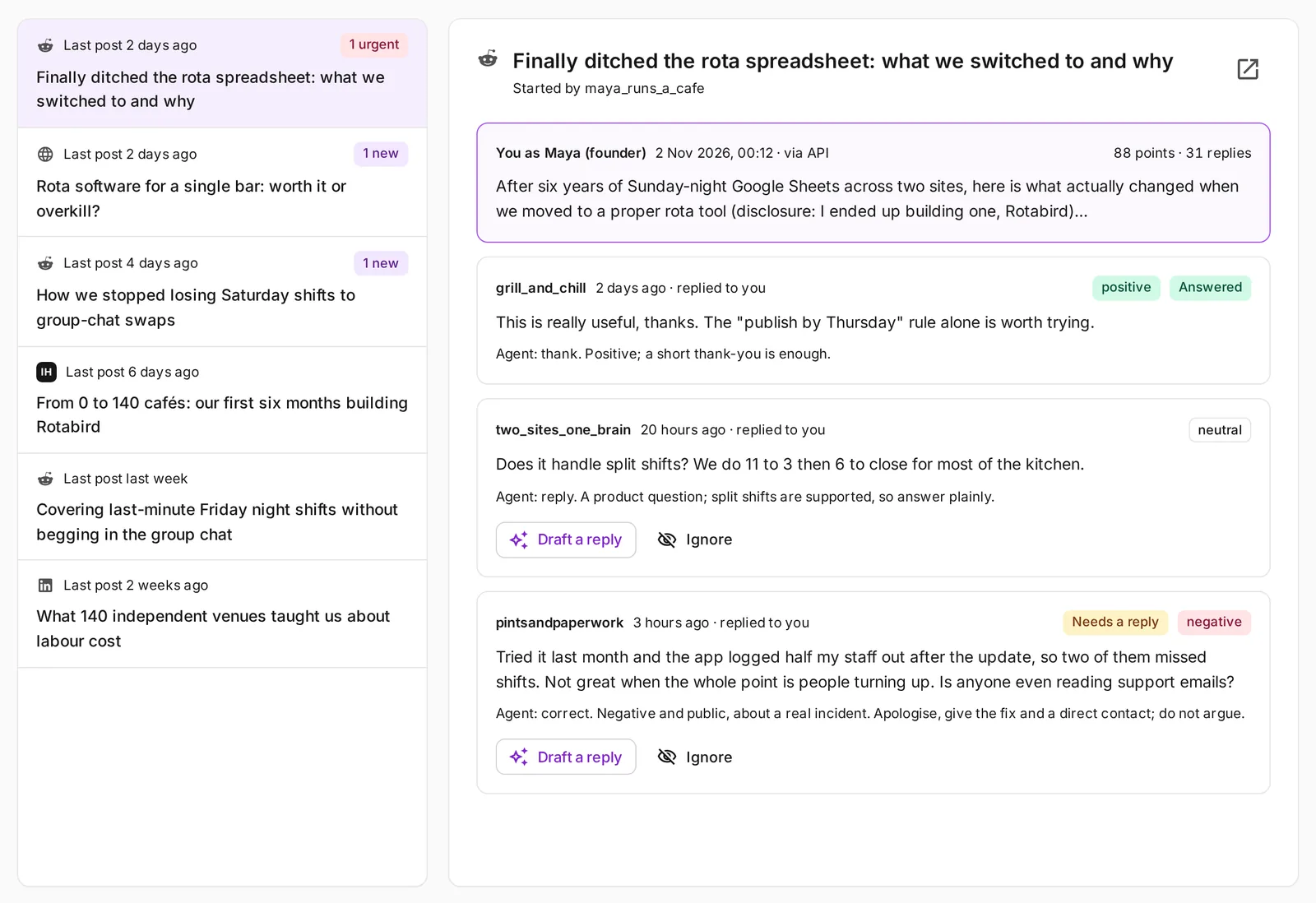
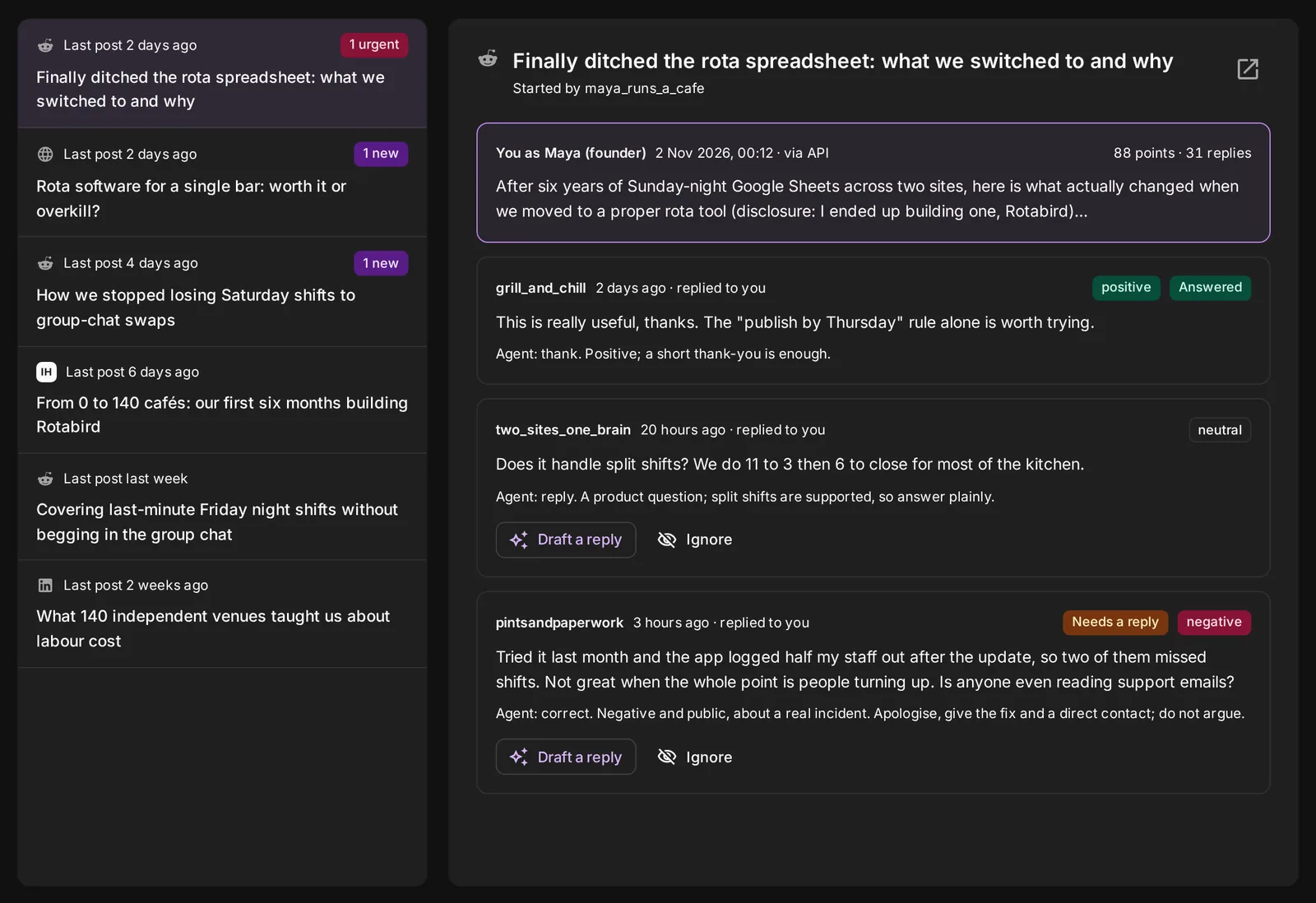
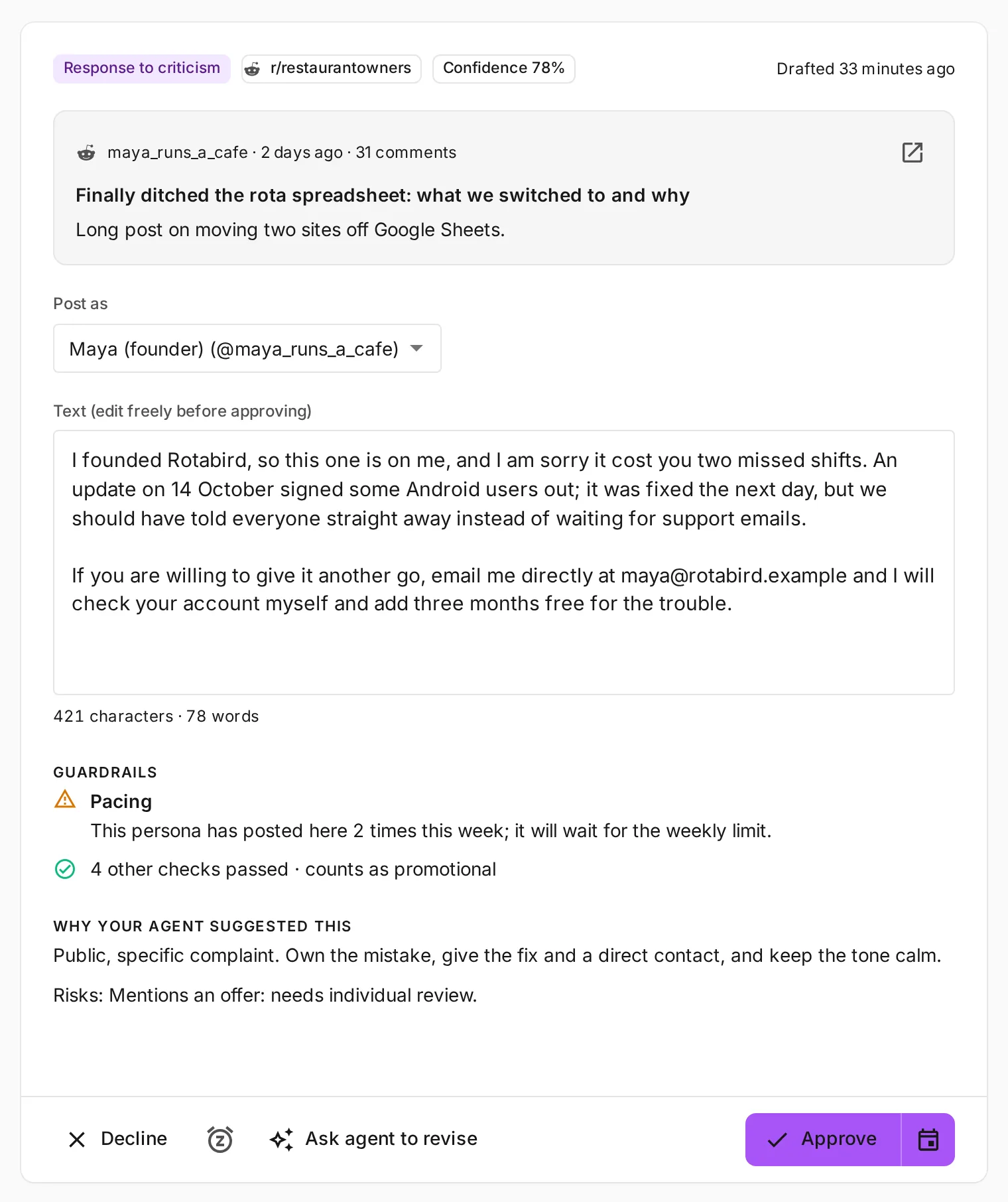
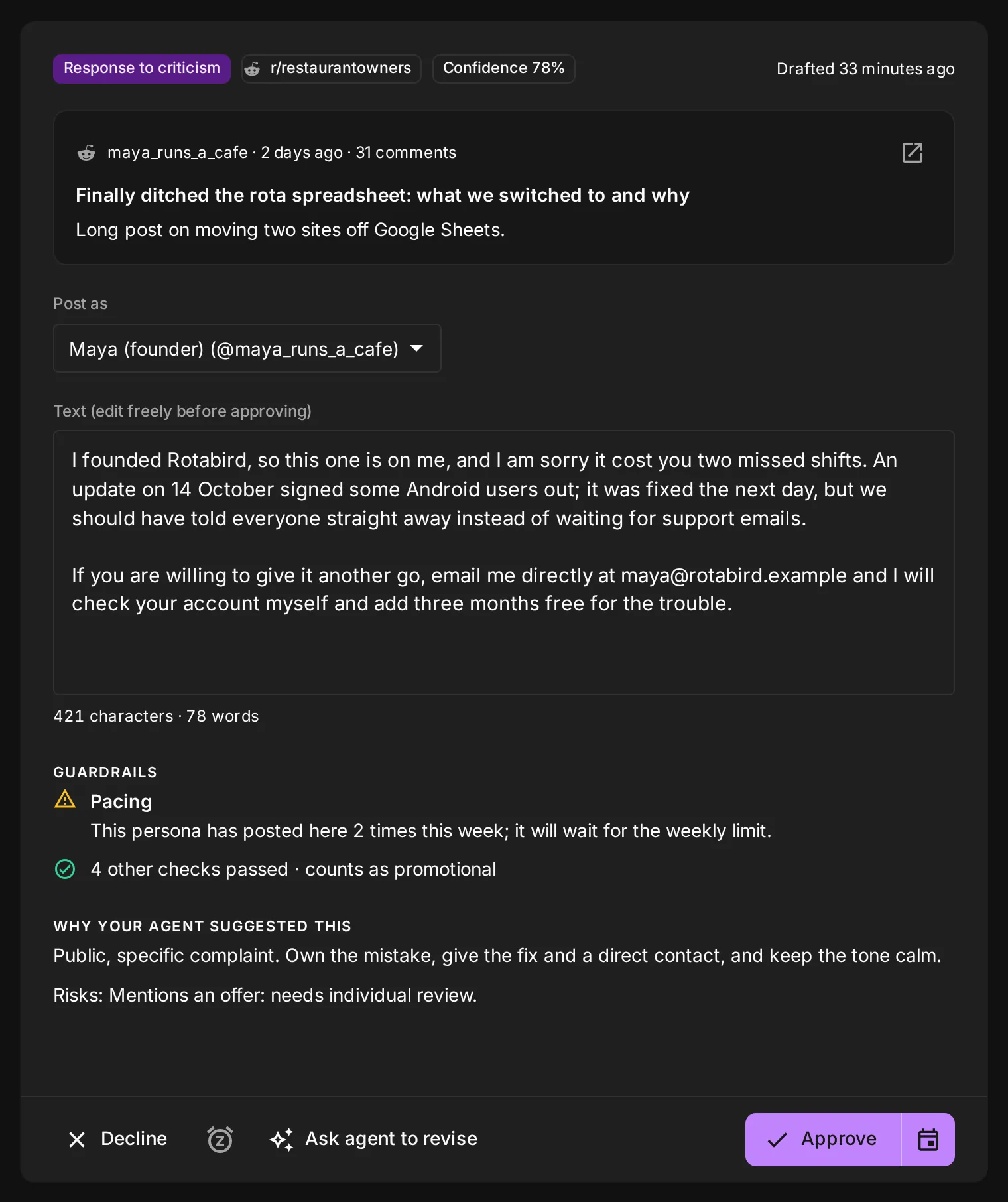
Your agent drafts the follow-up, whether it’s a thank-you, an answer to a product question or a reply to a complaint, and checks it like any other draft before it reaches you.
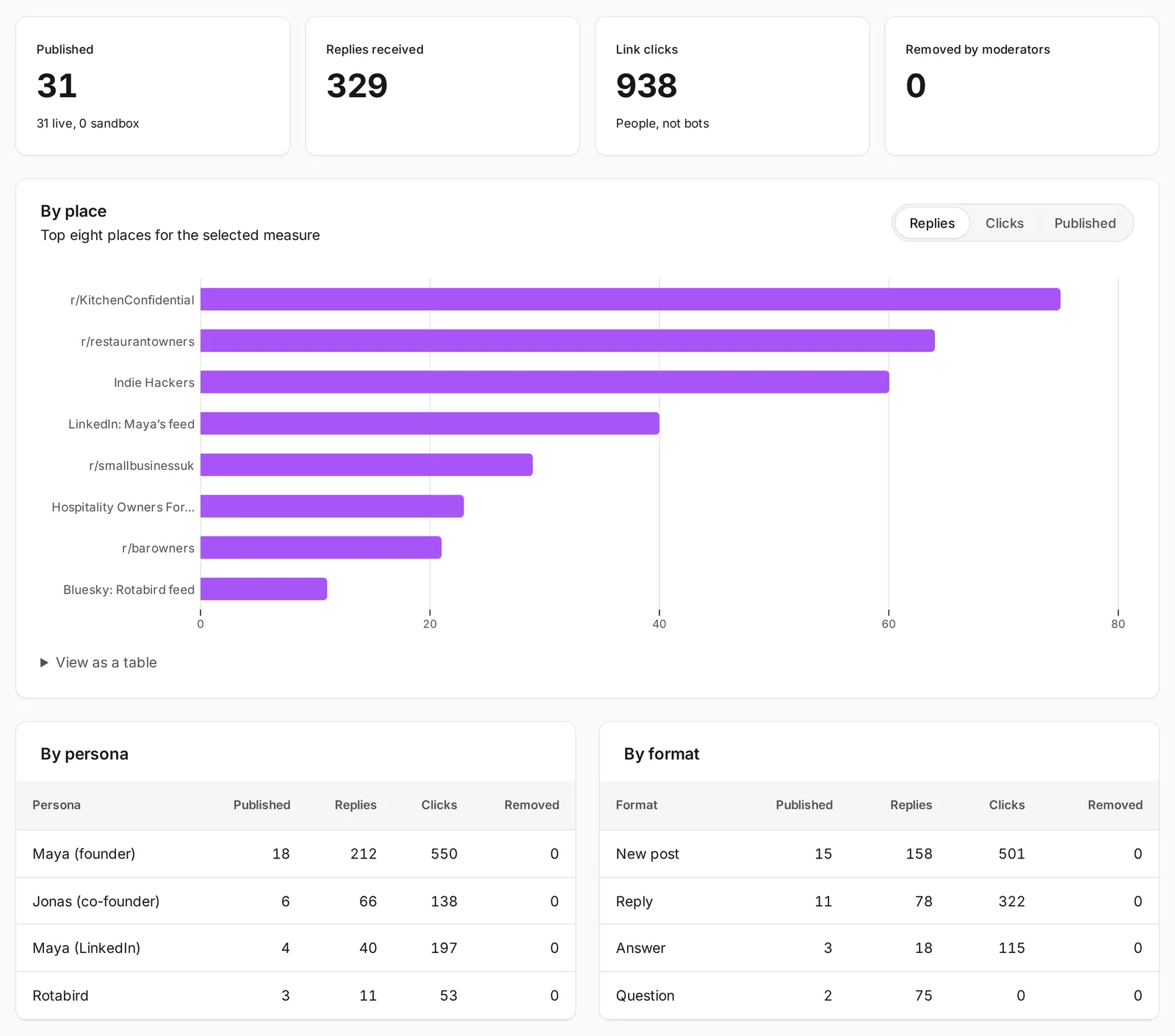
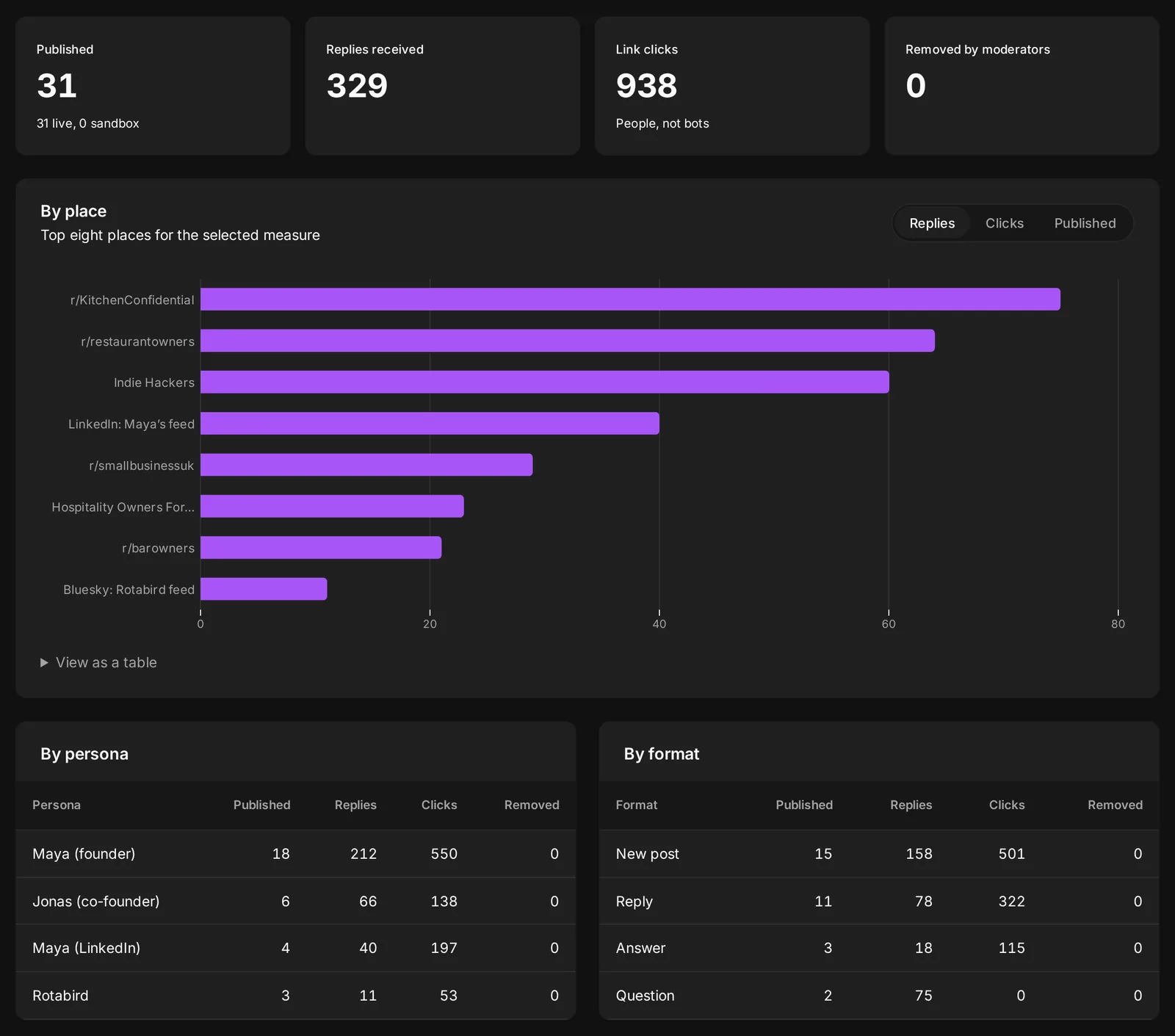
Replies, points, clicks and removals for everything you publish, by place, persona and format. Tracked links with UTM tags show which conversations bring visitors.
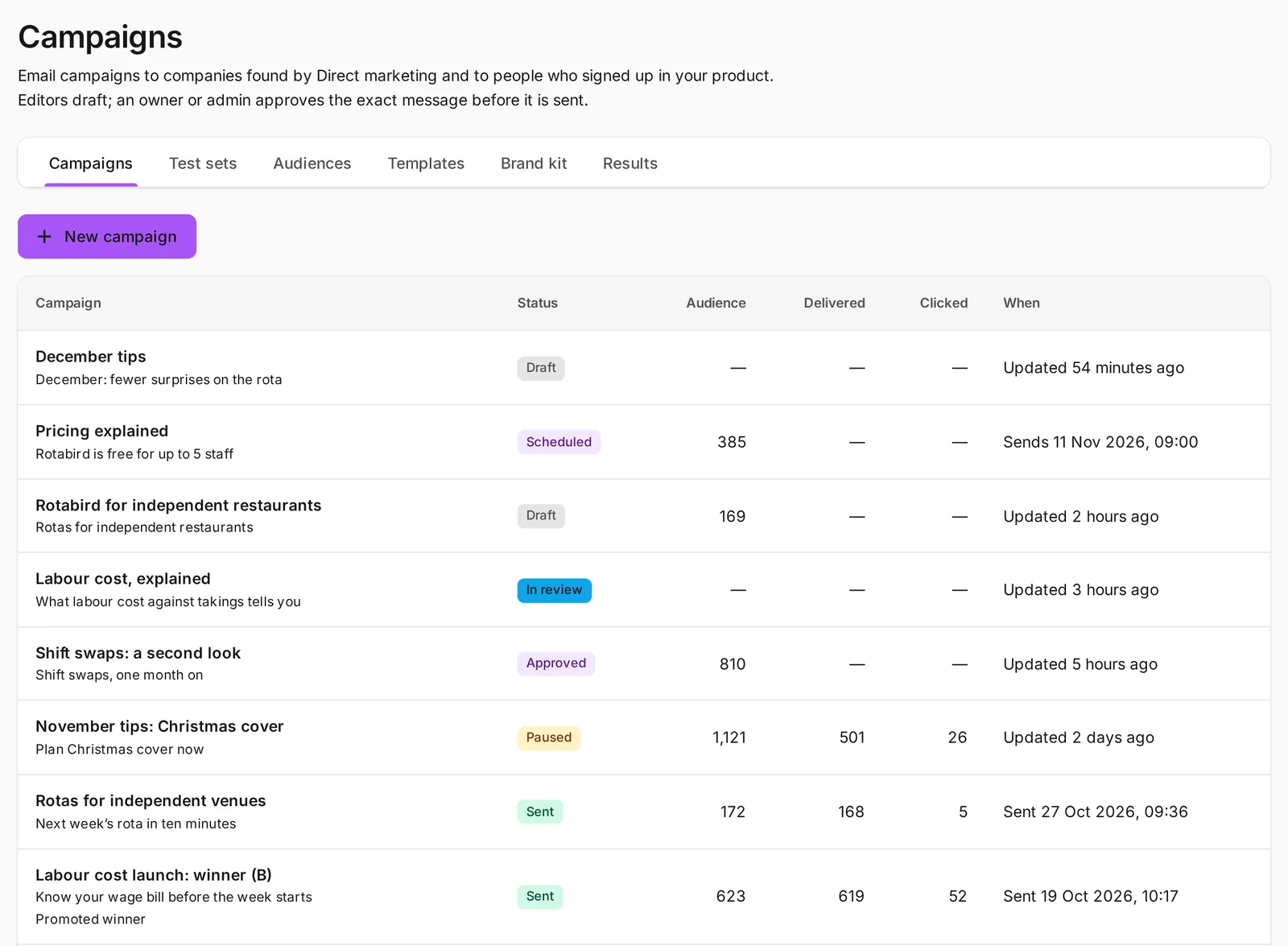
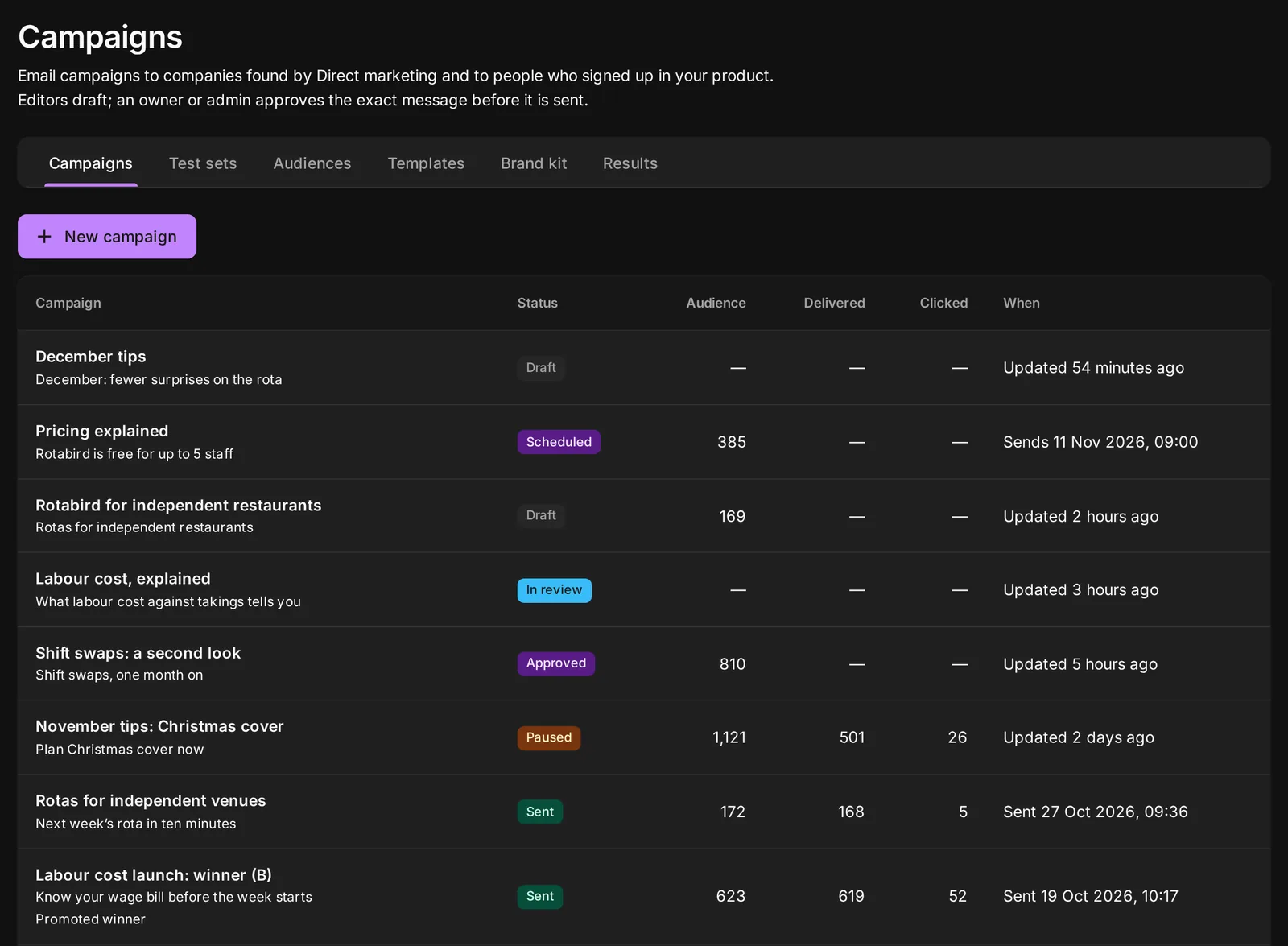
Campaigns reach the people who signed up in your product and the companies Direct marketing finds for you, cut into segments, approved by you and tracked from delivery to click. Here is Rotabird again, a few weeks after its launch.
Editors draft and an owner or admin approves the exact message; any change afterwards sends it back to draft. Schedule a campaign, pause it if you need to, and see at a glance what was delivered and clicked.
Combine people who signed up in your product with company contacts found by Direct marketing, then narrow them by region, industry, company type, mailbox, where they signed up and when, or how they engaged with earlier campaigns. The count updates as you go, with who is left out and why.
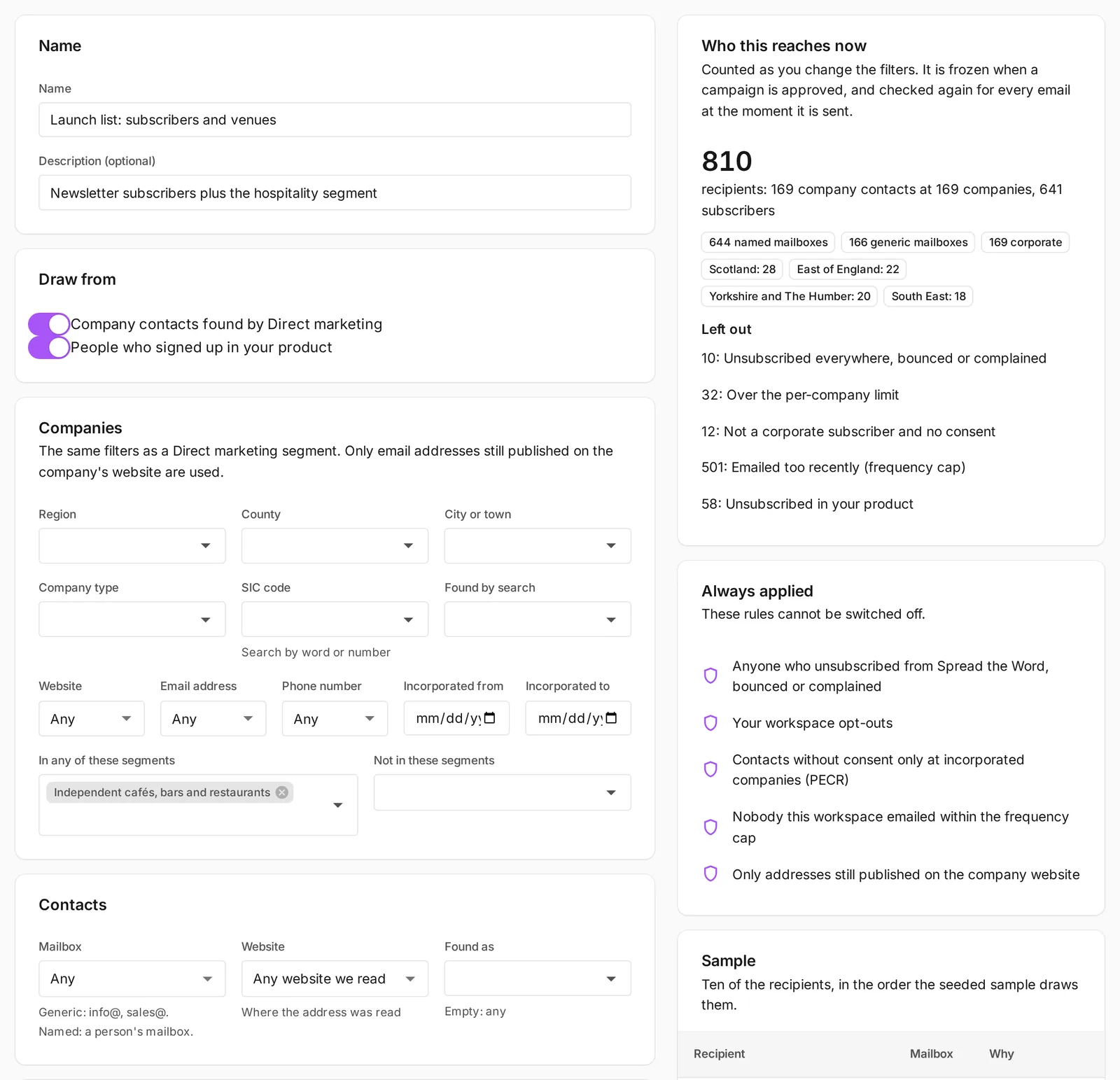
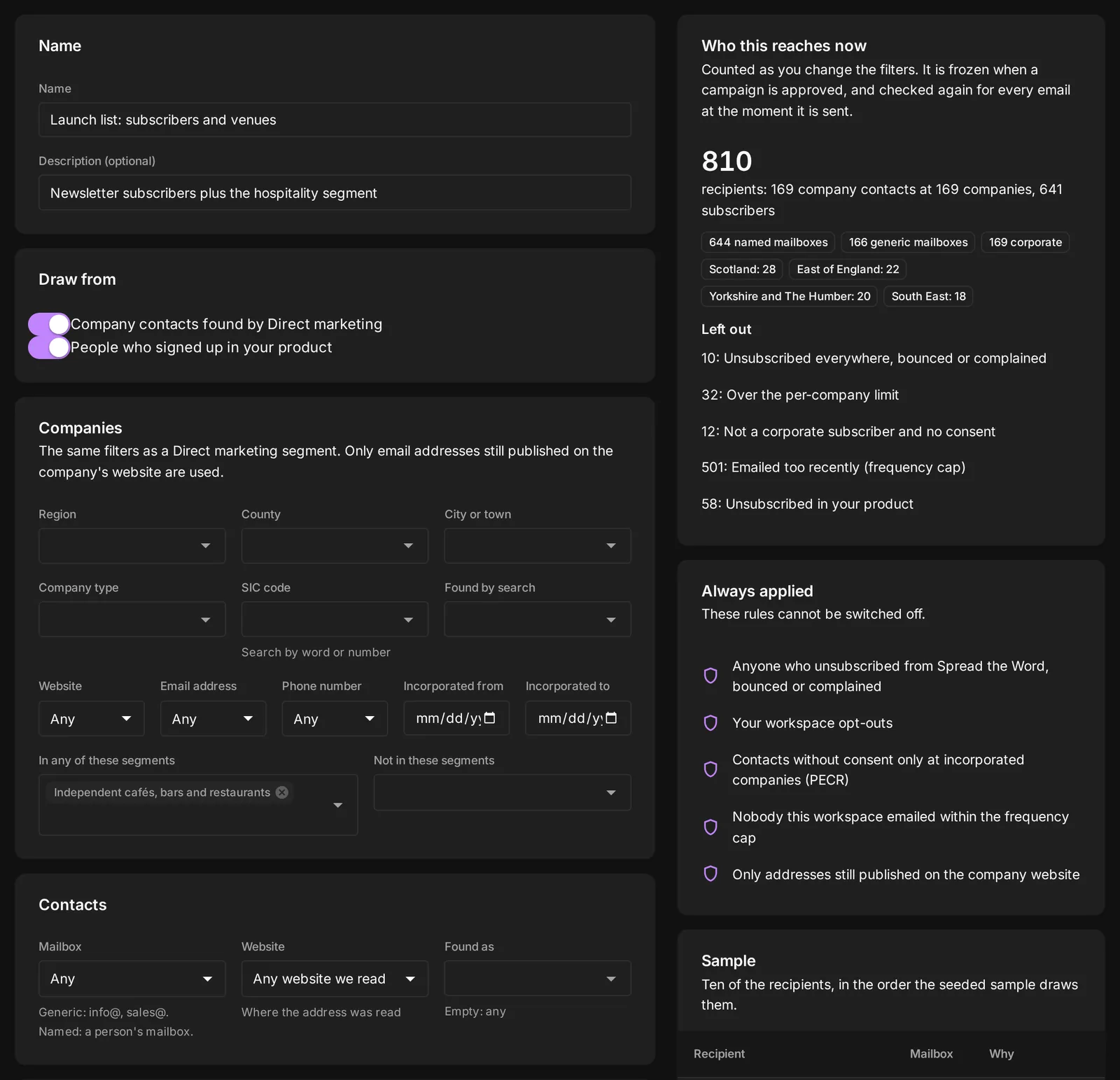
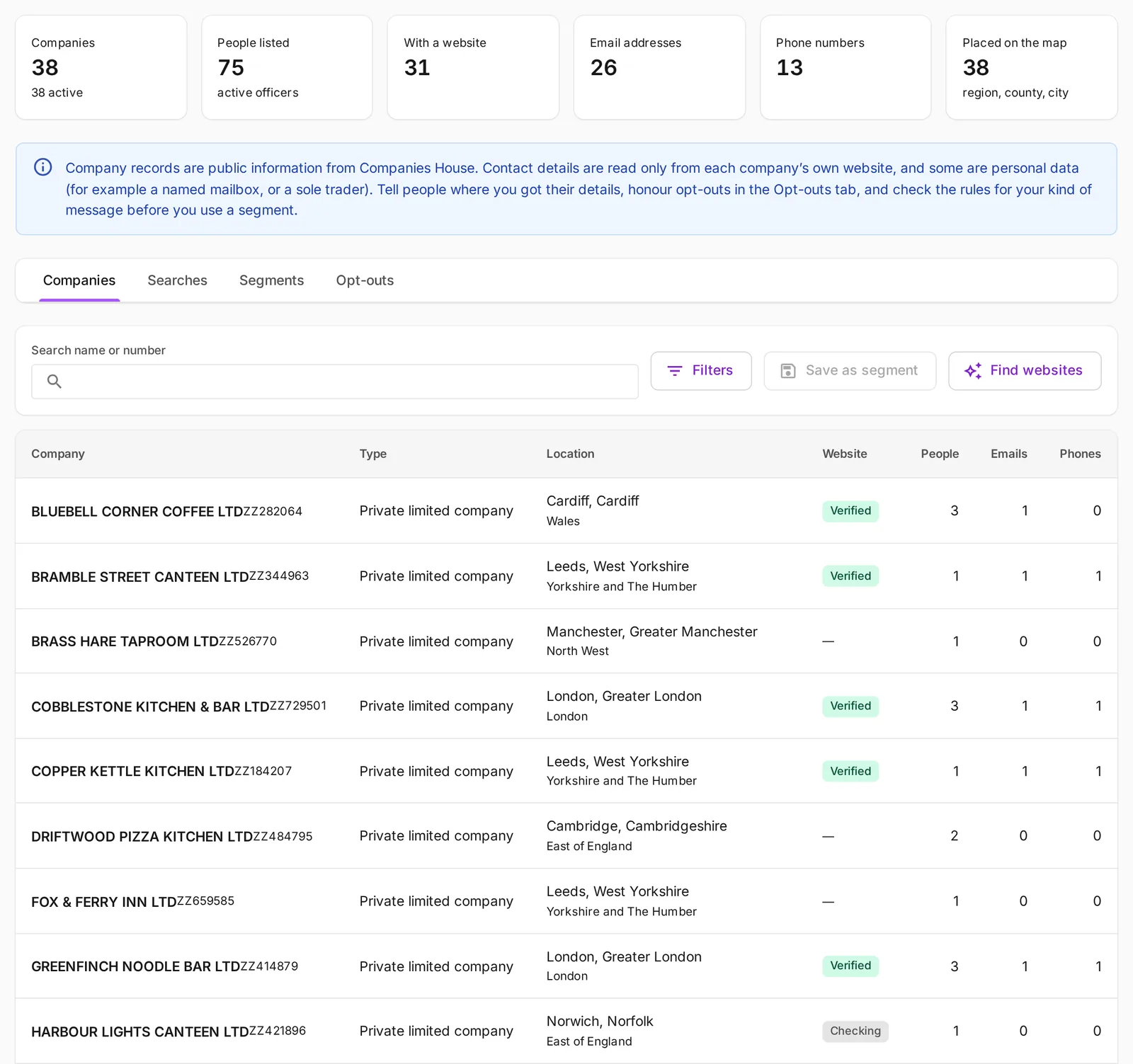
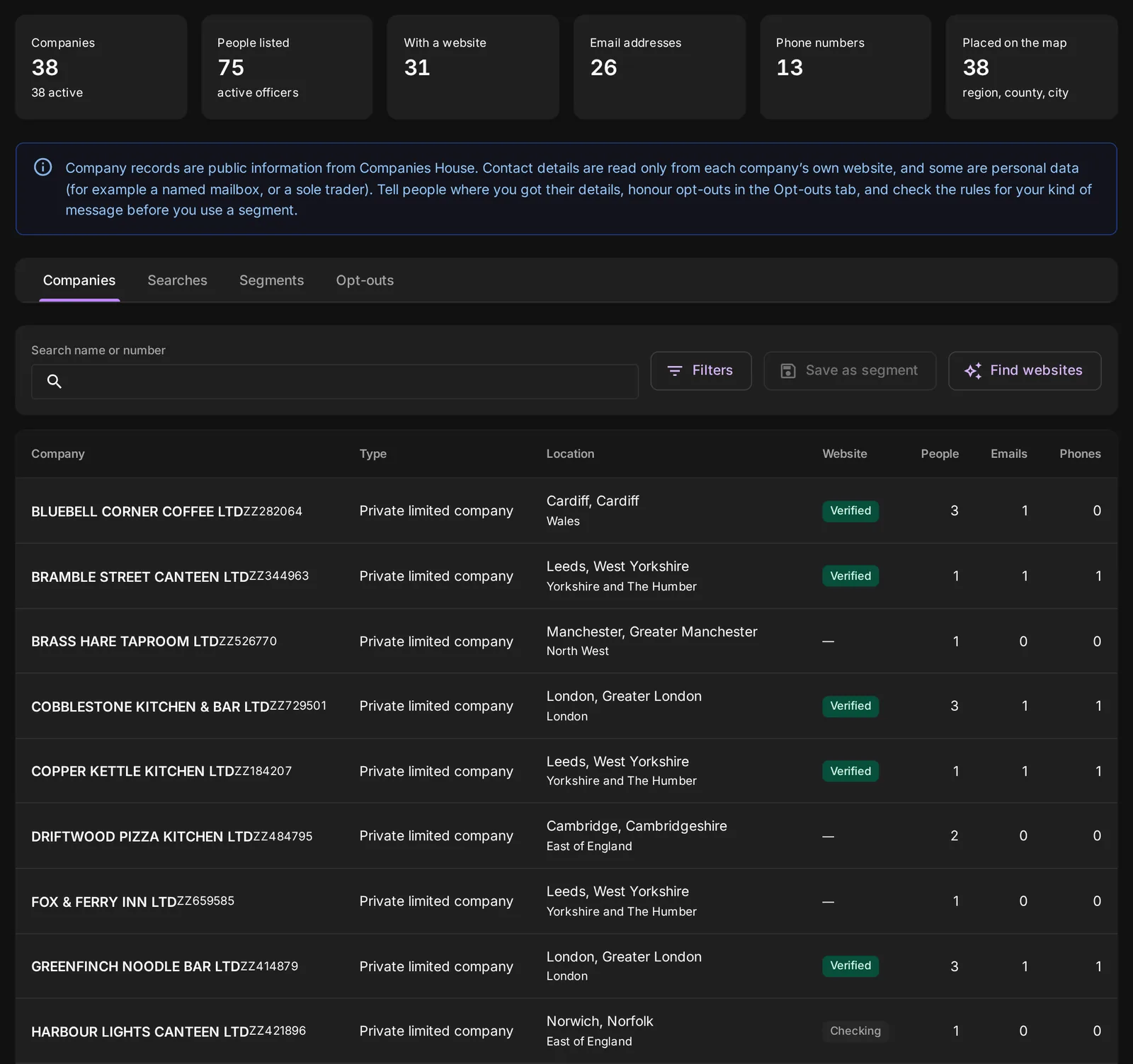
Build lists of UK companies from Companies House by industry, with the people listed against each one. Your agent finds their websites, published contact details are read from them, and every company is placed by region, county and city, ready to cut into segments and reach by email.
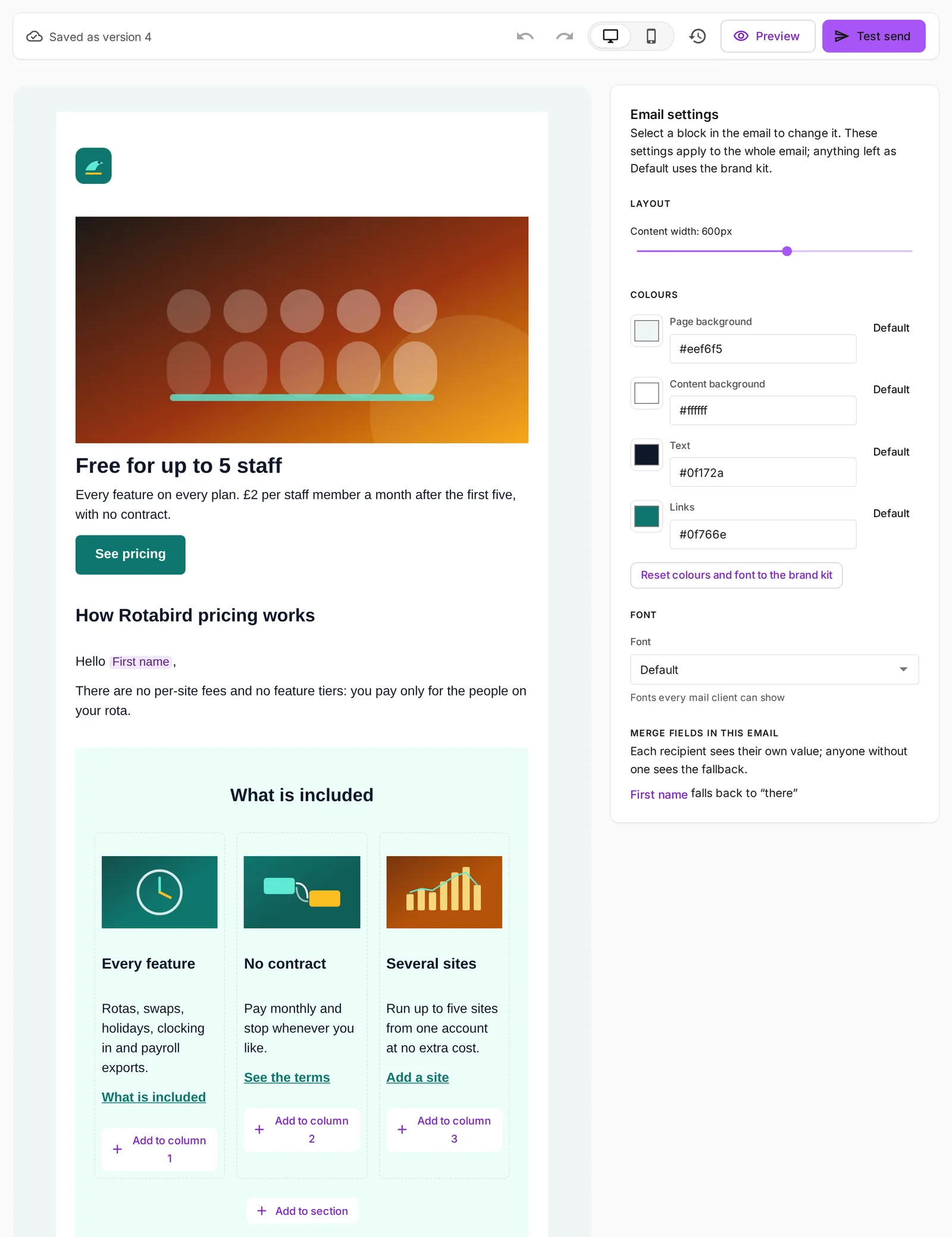
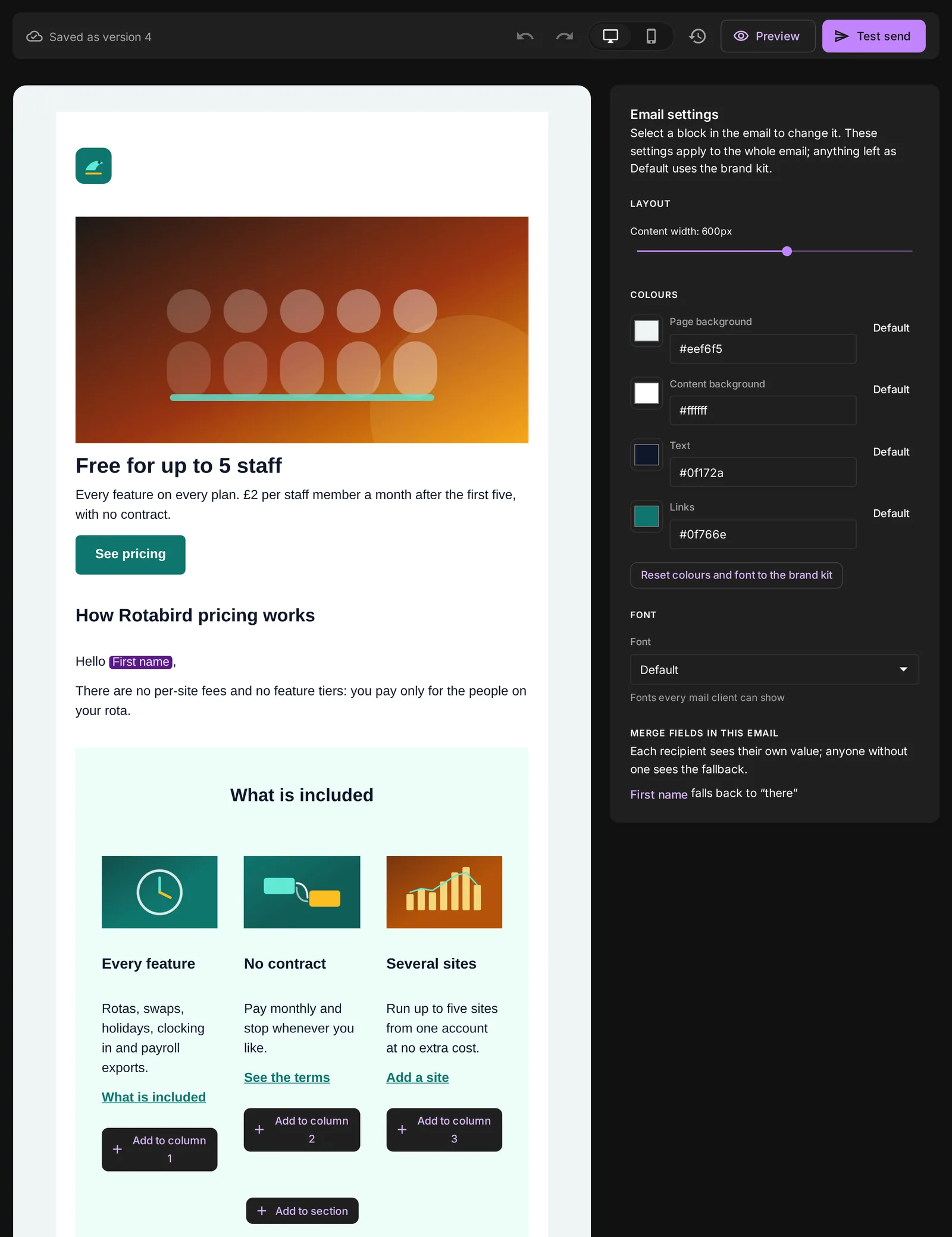
Build emails from sections, columns, images and buttons, with the logo and colours from your brand kit. Merge fields fill in each recipient’s details, you can preview on desktop and mobile and send yourself a test, and every save is a version, so what was approved is what is sent.
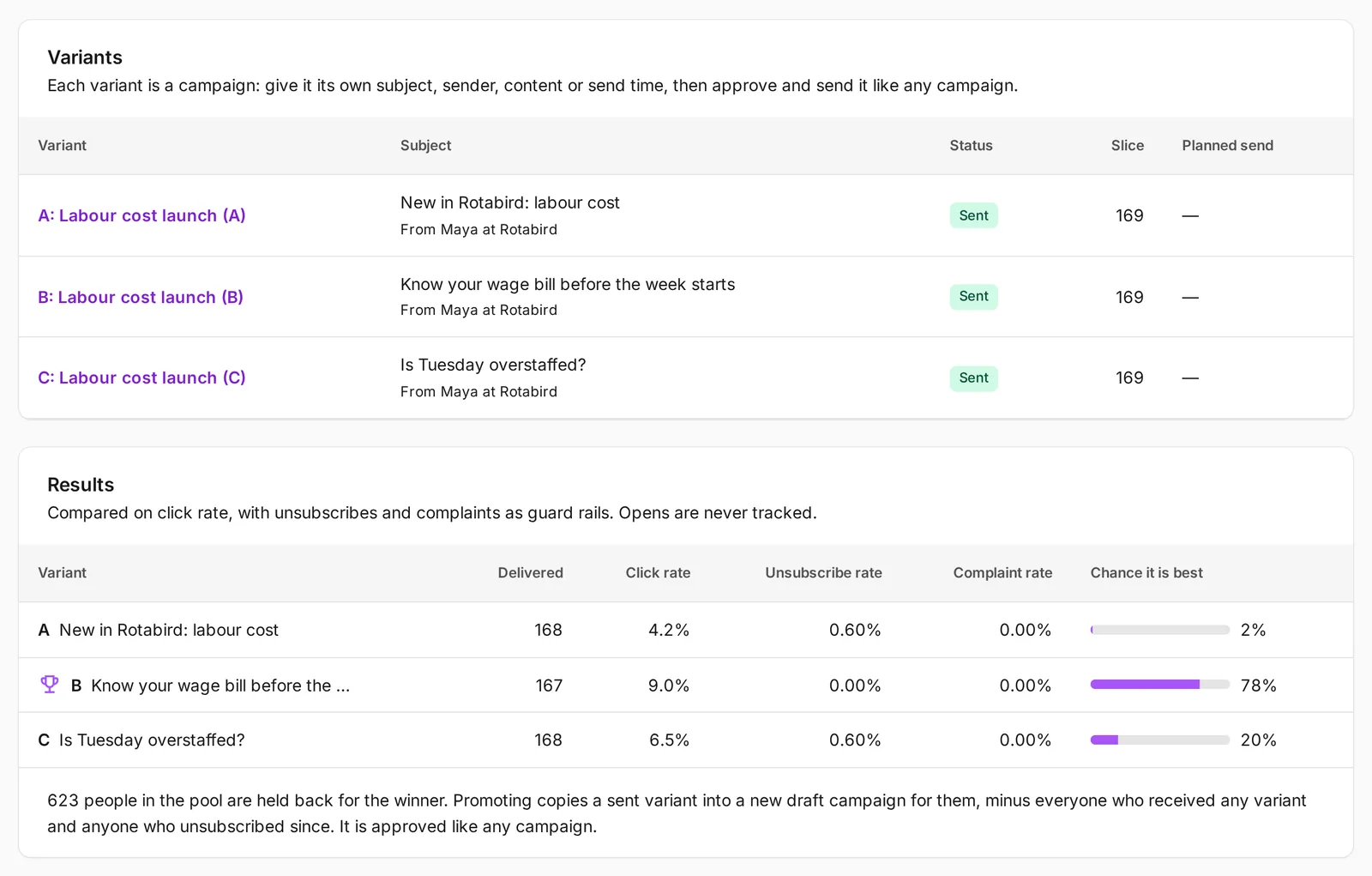
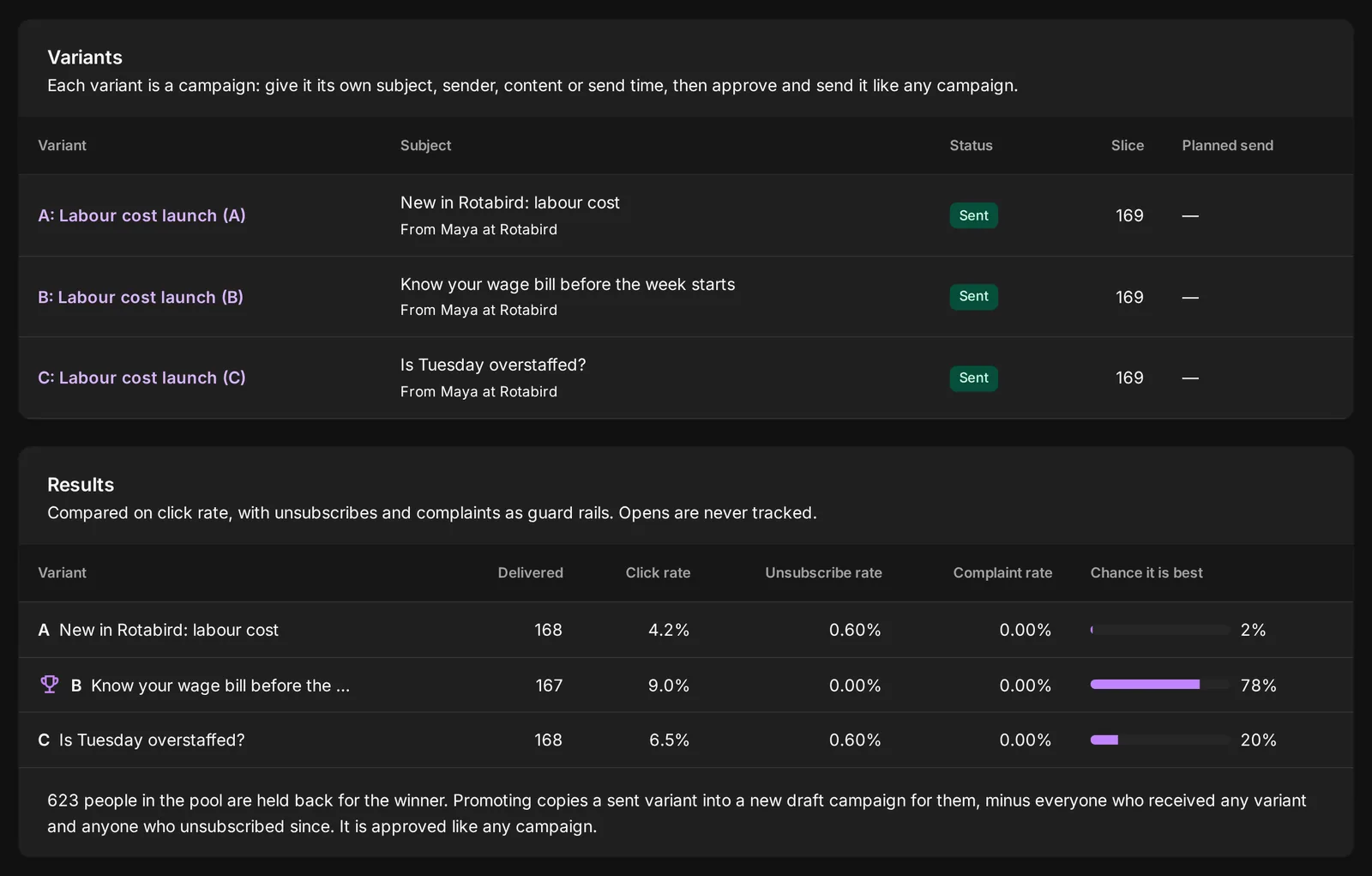
Send two to five variants, with their own subject, content or send time, to random slices of an audience. See each one’s chance of being the best, then send the winner to everyone else.
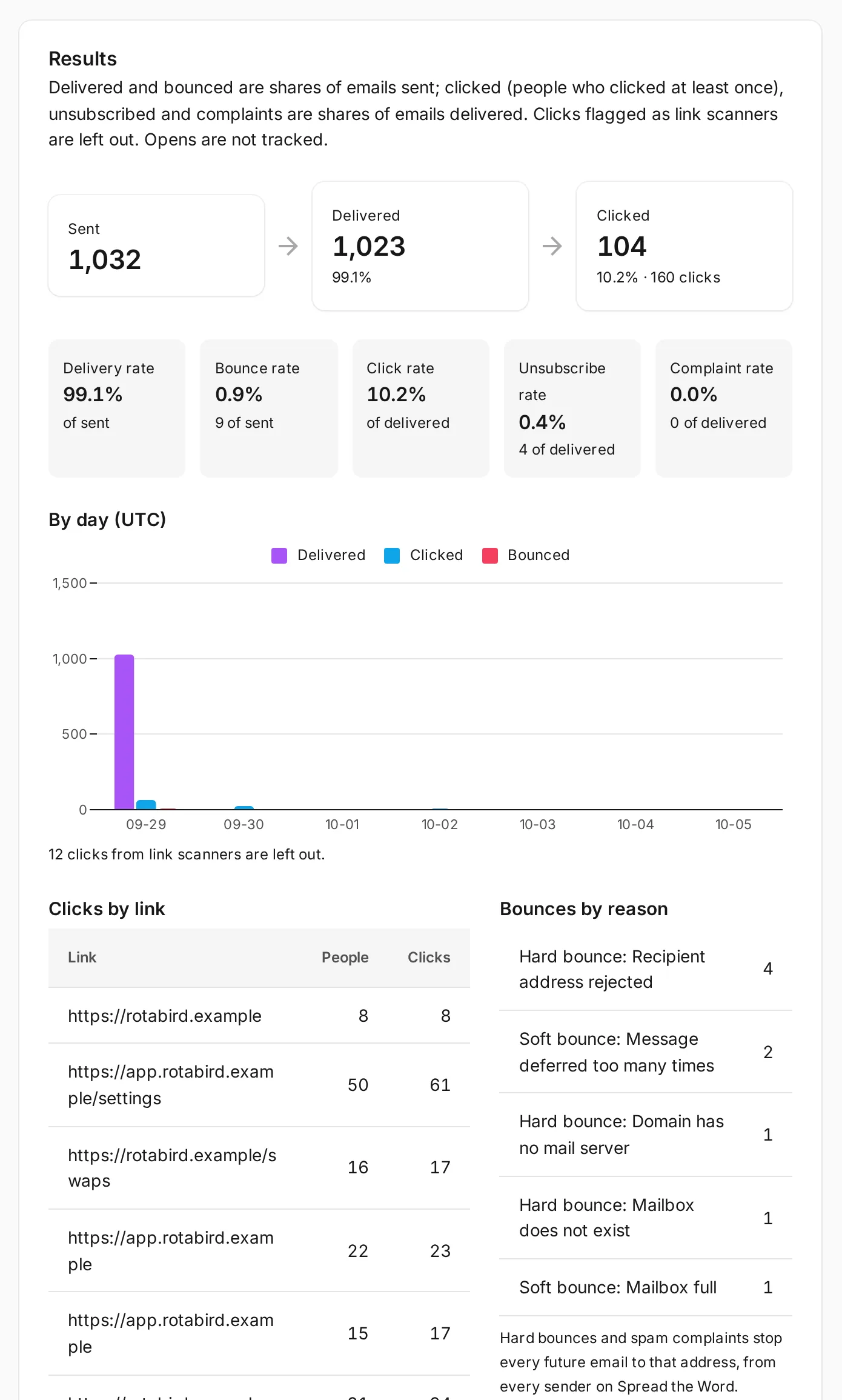
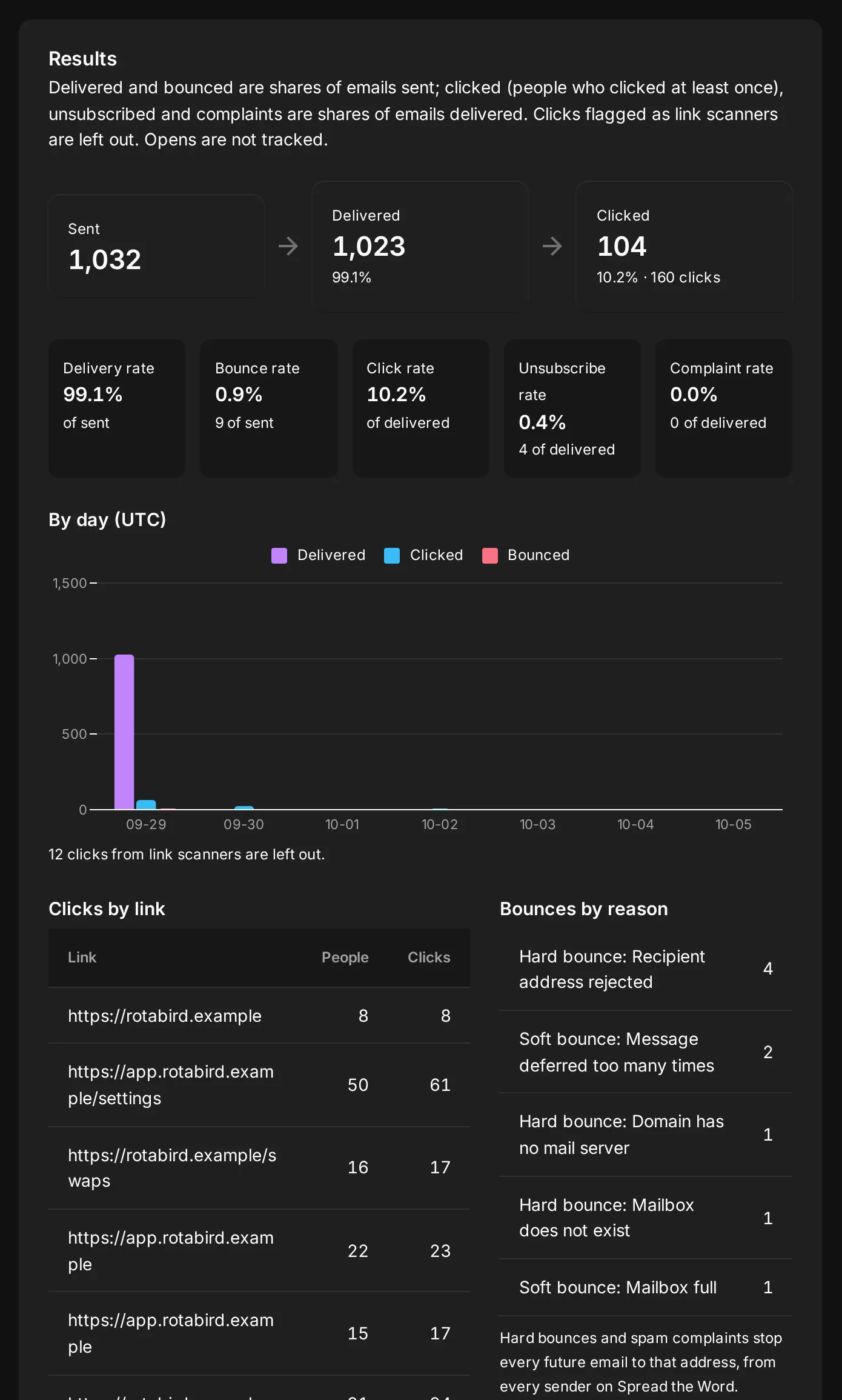
Deliveries, bounces, clicks, unsubscribes and complaints for every campaign, by day and by link, with UTM tags on every link so your own analytics see the visits. There are no tracking pixels, and the pages you link to never learn who a recipient is.
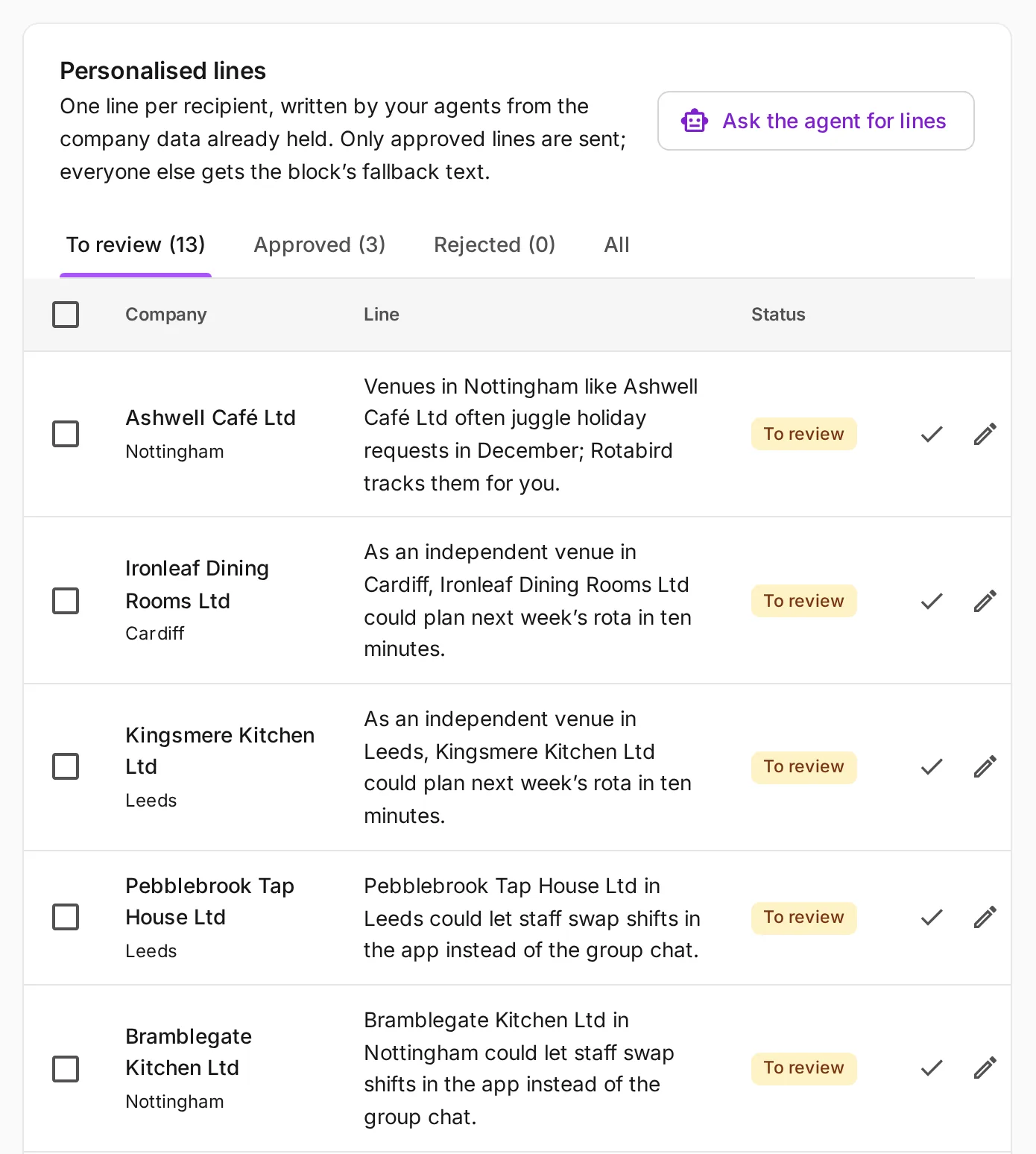
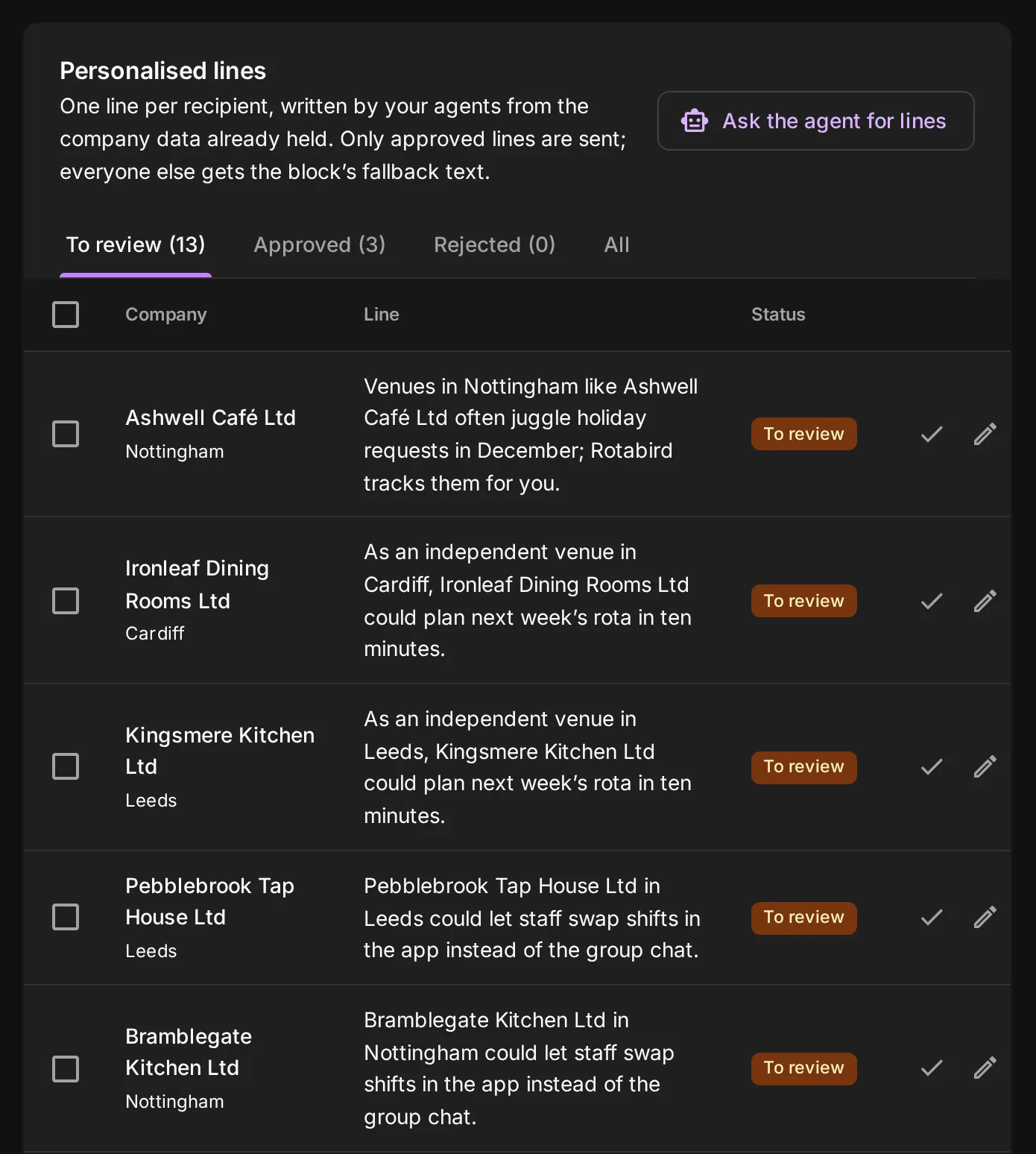
Your agents write one line per recipient from the company details you already hold: its name, industry and city. Approve, edit or reject them in bulk; anyone without an approved line gets the fallback text. Your agents can also draft whole campaigns and summarise how they did.
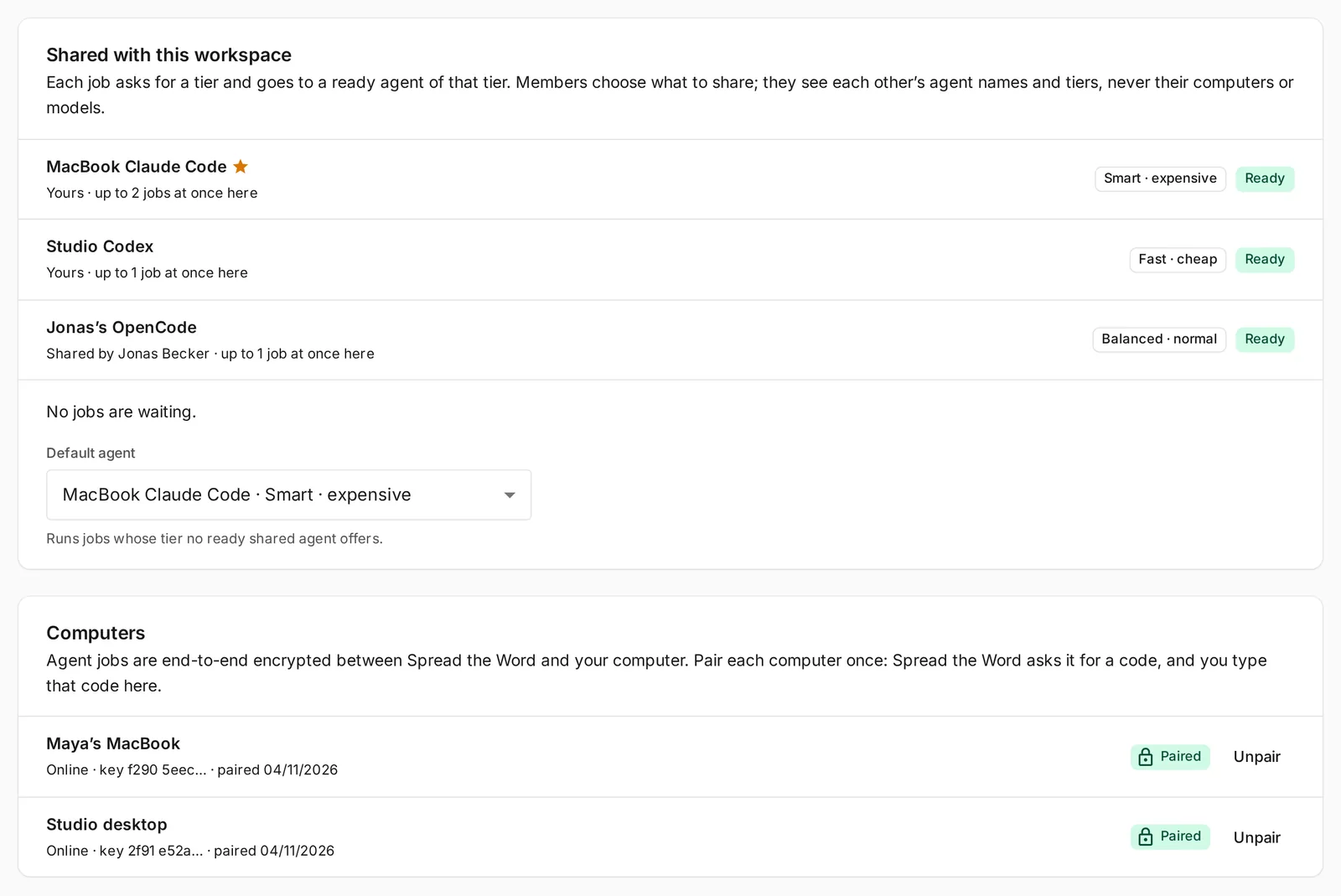
Research, drafting, personalised lines and results summaries run on Claude Code, Codex or OpenCode on your team’s computers, with your own subscription or a model you host yourself. Share agents across the workspace and pair each computer once; every job is end-to-end encrypted.
A launch is when your audience is most likely to notice you, and when it is easiest to break a community’s rules by accident, whether it is a brand new product or a big release for one people already use. Spread the Word prepares the work beforehand, keeps launch day on schedule and stays with the conversation afterwards.
Your agent finds the communities where your audience talks and summarises each one’s rules on self-promotion. Pick launch directories from the catalogue to get a launch kit for each, and ask for early-adopter offers within limits you set.
Approved posts go out at the time you choose. Platforms with an API publish on time; for Product Hunt, Show HN and directories you get the text, a checklist and the page to open. Tracked links show which places send visitors.
Replies are tracked, negative or urgent ones are flagged straight away, and your agent drafts the follow-ups. Then follow up by email with the people who signed up, and keep turning up in the threads where people ask about your category.
Combine product sign-ups and company contacts, then narrow them by place, industry, sign-up source or engagement, with a live count of who they reach.
Send from your own domain, set up with the DNS records shown for you and warmed up gradually, so your first campaigns land in the inbox.
Try two to five subject lines, versions or send times on slices of an audience, then send the winner to the rest.
Deliveries, bounces, clicks, unsubscribes and complaints by day and by link, with UTM tags on every link and no tracking pixels.
One-click unsubscribe, a footer that can’t be removed, a frequency cap, and nobody who has unsubscribed, bounced or complained is ever emailed again.
Your product adds subscribers through an API, with the consent they gave, and confirms their address first when you want it to.
Posts, emails and personalised lines are drafted by Claude Code, Codex or OpenCode on your team’s computers, with your own subscription or a model you host yourself. Our servers run no AI models, and agent work costs no credits.
Every persona discloses your affiliation unless you change it, and drafts are checked against each place’s rules before anything is posted.
A minimum gap between posts, daily and weekly caps, quiet hours and a limit on promotional posts, set for each persona.
No voting, boosting or sock puppets, and only one of your personas ever joins a thread.
Tracked links with UTM tags show which places, personas and campaigns bring visitors, alongside replies, points and clicks.
Every workspace starts in sandbox mode, so you can try the whole flow, posts and emails, before anything reaches a real platform or inbox.
Off by default. Switch it on for low-risk replies such as thank-yous, with an undo window. Everything else still waits for you.
Invite colleagues as owners, admins, editors or viewers: editors draft, owners and admins approve. Share your agents across the workspace.
No. Every draft waits for your approval, and an owner or admin approves the exact message of every email campaign; any change afterwards sends it back to draft. The only exception is autopilot for posts, which is off by default and, when you switch it on for a project, covers only low-risk kinds such as thank-you replies, with an undo window.
No. It works for teams of any size, from a founder on their own to a marketing team with several people drafting and approving, and for established products as well as new ones. It is at its best for new products and lean teams, where finding the first users matters most and there is nobody else to do it.
Your own Claude Code, Codex or OpenCode, run on your team’s computers, with any model it supports. OpenCode also runs models you host yourself. Spread the Word’s servers do not call any AI models, so your own subscription or hardware pays for the thinking.
No. Without them, Spread the Word gives you the text and a checklist, you post it yourself, and you paste the link so replies can be tracked. Connecting an account lets it publish through the platform’s official API where there is one. Credentials are encrypted and only decrypted at the moment of publishing.
Spread the Word is designed to follow community rules: it discloses your affiliation, paces posting, and warns when a place restricts self-promotion. It can’t guarantee a community will welcome a post, so read each place’s rules. Hacker News is always posted by you.
People who signed up in your product, with the consent they gave, and company contacts found by Direct marketing. Contacts who haven’t given consent are only emailed at incorporated companies, as UK rules require, and anyone who has unsubscribed, bounced or complained is always left out. You still need a lawful basis for each campaign. New workspaces send to their own test addresses first, until live sending is switched on with you.
Every account gets 1,000 free credits a month with no card needed. Credits are used when a post is published or checked for replies, and you can top up when you need more. Agent work and sandbox mode are free. Current prices are on the Spread the Word website.
The people who need your product are already asking about it in subreddits, forums and Q&A sites. Spread the Word helps you find those conversations and answer them well, in your own voice and within each community’s rules, so you build a reputation rather than a spam record. Then follow up by email, with segmented campaigns to the people who signed up and the companies you want to reach. It works for teams of any size, with new products and established ones, and it is at its best for new products and lean teams, when there is the most to do and the most at stake.
Visit the product website for the latest availability and plan details.